Hive mind
Some of the great artistic movements of the 20th century emerged from creative colonies, where painters, sculptors and writers lived and worked alongside each other
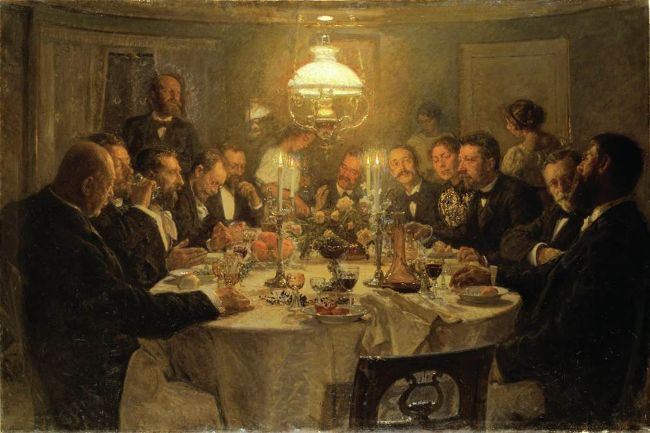
An Artist’s Gathering, Viggo Johansen, 1903
When British dramatist Samuel Foote, in his play, The Author, conjured the image of the reclusive writer – born in a cellar and living in a garret – he sowed the seed for a cliché that’s still going strong more than 250 years later. But while some creative souls have spent their lives largely in solitude, many painters – Claude Monet, Jean-François Millet and Otto Modersohn among them – found inspiration in the company of others.
The golden age of the artists’ colony was during the 19th century. From around 1830 until the eve of World War One in 1914, there was a remarkable efflorescence of these centres in rural areas throughout the world, starting in northern and central Europe and gradually spreading to America, Australia, Canada and Russia. Propelled by the desire to escape urban life and encroaching industrialisation, which they felt was damaging to their art, these artists clustered in small towns and villages in country locations such as Worpswede and Willingshausen in Germany, Fontainebleau and Giverny in
France, Laren in the Netherlands, Skagen in Denmark, and Newlyn and St Ives in England.
Away from the city, creatives could enjoy vast, starlit skies, raging seas and wide-open plains. They were driven, too, by a desire to immerse themselves in the authenticity of the lives of the people they painted, namely those who fished, worked the land or kept house for a living.
Nina Lübbren, associate professor of film and art history at Anglia Ruskin University, Cambridge, and author of Rural Artists’ Colonies in Europe, 1870-1910, and Narrative Painting in Europe, 1830-1895, explains: ‘The 19th century was a time of naturalistic painting in Europe, a time when landscapes and depictions of rural life were key themes. Many painters had already built a reputation for their portrayals of village scenes. Millet had his French peasants, for example, Marie and Peder Severin Krøyer, working in Skagen, had their fishermen, and English painter Laura Knight, who went to live at the artists’ colony in Laren, had the women who gave her that fly-on-the-wall perspective that so defined her work. The artists who congregated in rural communities felt the only honest way to capture the scenes they sought was to leave the cities so they could paint en plein air, immersed in the communities that inspired them. Of course, the conviviality, camaraderie, cheap lodgings and affordable models were also an incentive, but really, they were an added bonus. The main motive was to paint natural nature.’