HEAVY HITTER
Doom looks to the past for its biggest – and weightiest – iteration yet
By Jon Bailes
Game Doom: The Dark Ages
Developer Id Software
Publisher Bethesda Softworks
Format PC, PS5, Xbox Series
Origin US
Release May 15
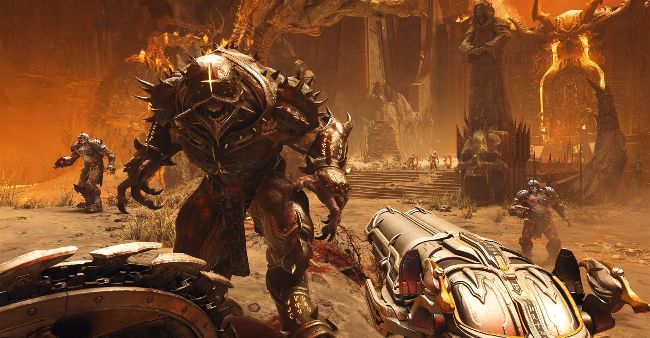
Shield rune effects range from electrocuting an area to a machine-gun turret spawning on your shoulder.
Defence really is the best form of attack, it seems – or at least the most satisfying. With the Slayer busy focusing fire on its brethren, a burly hell knight flanks him to the right. Stomping into range in the Slayer’s peripheral vision, it launches itself forward for a double-fisted slam. The Slayer rotates, raises his shield and – pang! – the hell knight comes off worse from the collision, the Slayer unmoved, shockwaves reverberating, the demon reeling. To follow, two punches and a dismissive boot that sends the half-ton monster’s broken body arcing over a nearby precipice.
Parrying is a familiar component of videogame violence these days, but in Doom: The Dark Ages its inclusion is as much about what it communicates as its table-turning effect. The rippling, green shockwave on a timed block or projectile deflection conveys the point that evil simply bounces off you here. Indeed, from the soaring acrobatics of Doom Eternal, this prequel casts you as a hulk. When PR materials suggest this game is more ‘grounded’, it isn’t meant in the sense of a stronger basis in reality – the mayhem in The Dark Ages will have anything but. Rather, it’s grounded quite literally – you’re stripped of the luxury of a double jump and too bulky to leave terra firma for more than a short hop.
For the two faces of the modern Doom games, studio director Marty Stratton and game director and studio creative director Hugo Martin, the desire to create something big and heavy has endured a lengthy gestation. “We’ve been thinking about it since 2016,” Martin says. A prototype codenamed Slayer Year One was inspired by the comic Batman Year One, with the aim of returning to the roots of the character. Another classic Batman comic, The Dark Knight, which depicts the caped crusader as a hefty brute, was also an influence. The fantasy setting was already in mind, too: a faction in The Dark Ages’ story, the Sentinels, was laced into the fiction from Doom 2016, their culture defined as medieval. “It’s interesting to go back and look at some of our early prototypes,” Stratton says. “It’s amazing to see not only how far they’ve come, but how the vision was so tangible.”
IT’S GROUNDED QUITE LITERALLY – YOU’RE STRIPPED OF THE LUXURY OF A DOUBLE JUMP AND TOO BULKY TO LEAVE TERRA FIRMA
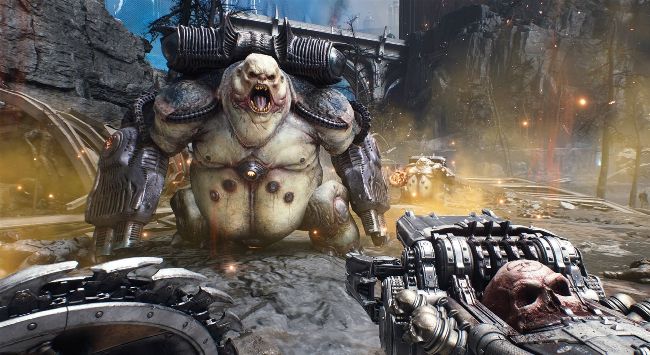
Glory kills return but now trigger from any angle, instead of locking you into an animation in front of your foe
HURT ME GENTLY
Alongside the standard
Doom
difficulty levels, you’ll find a range of accessibility sliders to tailor
The Dark Ages
to your tastes. “The rule was that it’s got to be good for both white belts and black belts,” Martin says. As well as more obvious variables such as damage taken and received, then, you can adjust the likes of parry-window length, daze duration and the overall speed of the game. These changes can also be paired with different difficulty options, which work independently. “There are certain variables that are handled on the back end that aren’t exposed in the sliders,” Stratton explains. And, Martin adds, all of these settings can go up as well as down, including increasing game speed, which should lead to some daringly strange custom combinations.
The Dark Ages would have to wait its turn, however, with 2020’s Doom Eternal ahead in the queue. To continue the pattern of the original series, as 2016 was a reboot of the first game, Eternal reworked Doom II, taking the fight to Earth. Only after that did it feel right to go off-piste (there’s no mention of Doom 3 here, which increasingly feels like the family’s black sheep). “You follow the IP development rulebook that was created by a lot of great people, [such as] George Lucas,” Martin says. “You start with a fictional world that has a history, characters and heroes that have a past, and then, and if the audience likes what you made, you get to explore that in sequels and prequels.” He and his team are fortunate to have that chance, he adds, with two acclaimed games behind them. His tone is one of hunger and excitement. “The motto throughout the studio for me, Marty and everyone has been, ‘Let’s try to make the best game we’ve ever made together’.”