EARLY STRADIVARI VIOLIN PATTERNS
Forms follow function
Unlike his contemporaries, Antonio Stradivari was trying out different violin patterns from the start of his career as a luthier. Philip Ihle examines a number of his early violins to discover how his art evolved
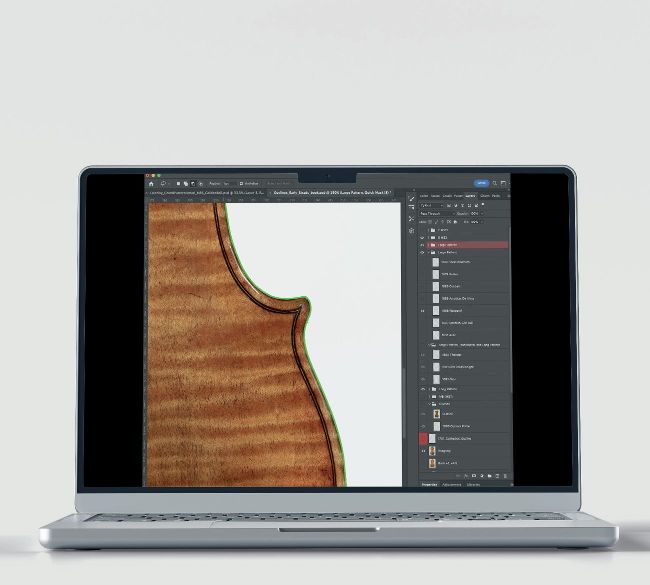
FIGURE 1 Screenshot of the 1686 ‘Rosgonyl’ Stradivari in Adobe Photoshop, with layers visible on the right-hand side
‘ROSGONYL’ PHOTO JAN RÖHRMANN
What violin patterns did Antonio Stradivari use at the start of his violin making career and how are they related to the Amati workshop that was dominating the trade at the time? For the research presented here, I have compared all the 46 earliest violins featuring in volumes I–VIII of Antonius Stradivarius, published by Jost Thöne Verlag with photography by Jan Röhrmann. This publication features nearly half of the 650 surviving instruments by Antonio Stradivari. The findings of this research are based exclusively on this selection of 46 violins.
We have a good knowledge of the patterns Stradivari used for his violins at the peak of his production from 1700 onwards. We also know the easily recognisable ‘Long Pattern’ violins in his most experimental decade leading up to 1700. The 25 years prior, however, are less understood, as fewer violins from that period have survived and, at first glance, his work seems less consistent. It has only been in the past few years that we have had access to undistorted high-quality photos of a significantly large number of violins, which allow a proper analysis of his patterns to be made.
Andrea Amati, the father of Cremonese violin making, was the first luthier we know of who built violins on an internal mould. He also built them in two different sizes; they were tuned to the same notes, but used for different voices in the music. Measuring with a tape measure over the back of the violins, we get a length of c.342mm for the smaller pattern and c.353mm for the larger one. They were both of similar proportions, except in the C-bouts where Andrea did not increase the width by quite as much as he would have by simply enlarging the smaller model.
Andrea’s grandson Nicolò Amati, the most influential teacher of the classical Cremonese school of violin making, similarly used two sizes. His so-called ‘Grand Pattern’, introduced by 1628, was adopted by Nicolò’s contemporaries and 90 per cent of the violins ever built follow roughly these dimensions. Table 1 shows the measurements for the ‘Grand Amati’ and ‘Small Form Amati’ patterns, as taken from the Hills’ 1903 book Antonio Stradivari, His Life and Work, along with two typical Stradivari violins.
Whereas with Andrea Amati the difference between the big and the small patterns was greatest in length, that of the small and larger Nicolò Amatis is particularly pronounced in width.
Andrea Guarneri, G.B. Rogeri and Francesco Rugeri were all apprenticed to and employed for many years by Nicolò Amati. When they left to set up their own workshops, all three simply copied the two moulds of their master, and built hundreds of violins on these very same patterns. Antonio Stradivari, however, was different. We have no evidence that he was apprenticed in the Amati workshop. It is believed that he came to violin making as a career change after some other background in fine woodwork. As we know, he used a far larger number of moulds throughout his long and prolific career. In addition to the great number of surviving violins, Stradivari’s consistency of method and clean workmanship make him a compelling choice for research. We are also fortunate that most of the moulds he used to build his violins on have survived and are accessible to us all through numerous publications, most notably François Denis’s Traité de Lutherie.