Porsche and Tamiya
Role Models
Seven visits to Stuttgart, a deconstructed 911 and an expensive model mould of a 934: Total 911 unearths the history of the iconic partnership between Porsche and Tamiya Model Company
Written by Kyle Fortune
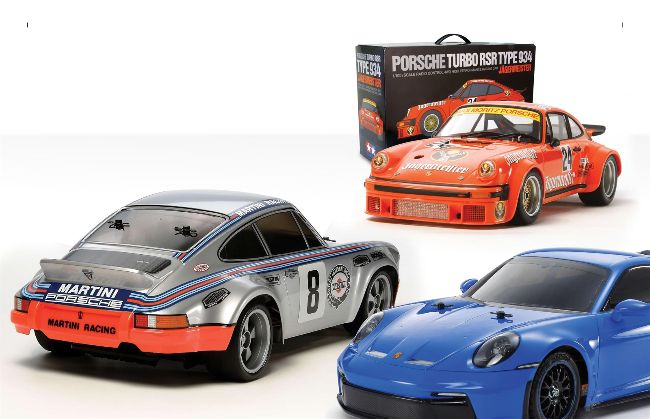
Pictures courtesy Tamiya and Kyle Fortune
It is well-established now that Porsche’s survival can be attributed, in no small part, to Wendelin Wiedeking inviting Japanese kaizen practitioner Chihiro Nakao to sort out the company’s production inefficiency. Overly complex, non-standardised parts; an inventory of 28 days’ stock; Nakao’s remark “A terrible plant, but there is hope”; and the company’s subsequent adoption of the famous Toyota Production System offer a perfect example of how a failing business can be turned around. It’s one that’s still referenced in countless business texts to this day.
In the early 1970s, long before Nakao set foot in the Porsche factory, another significant Japanese visitor had been to Stuttgart. Shunsaku Tamiya from Tamiya Model Company had asked Porsche if he could view the build process on its 934 race car. It wasn’t Tamiya’s first trip: he had previously visited a decade earlier for a similar viewing of the Carrera race car.
Porsche agreed to the 934 request, and Tamiya visited, becoming enthused at the idea of creating a model that matched the build process of the actual car. He returned to Japan to collect the designer in charge of the model’s production to document this; but when the pair arrived back in Stuttgart, they were told the car had been sent to race at Silverstone. Tamiya followed it there. Over seven subsequent visits to Germany in a period of 12 months, Tamiya would research the car in great detail, the modeller saying: “The people at Porsche headquarters were astonished by my persistence.”
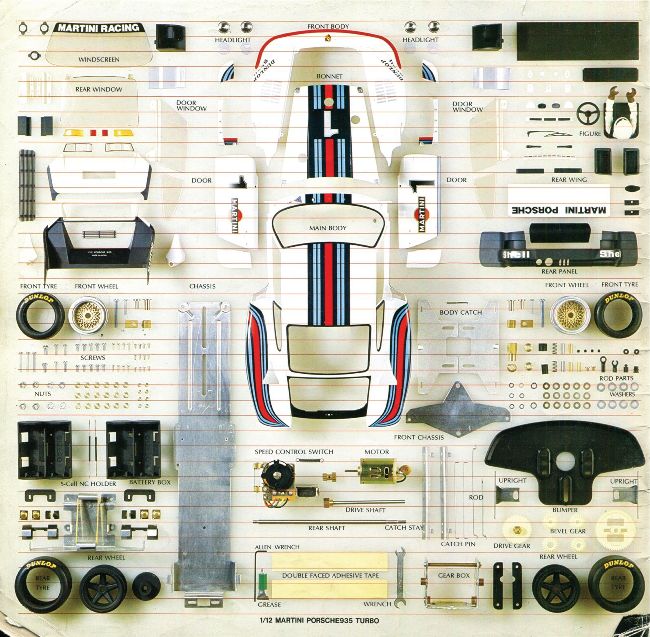
First released in 1977, the Martini Porsche 935 is one of the first examples of Tamiya self-build, radiocontrol Porsche scale models
Over those numerous visits, Tamiya was permitted to photograph and sketch, but Porsche wouldn’t let him take measurements. Tamiya would circumvent that by purchasing a 911 back in Japan, then taking it apart in his garage with a team of his modellers and designers. The group fastidiously measured every component as it was disassembled, getting crucial details to allow the realism of the subsequent model. Tamiya admits that they were so absorbed in doing so that nobody had considered the reassembly. Admitting defeat, they called in help: the technician from the Japanese Porsche dealer who was tasked with rebuilding it was apparently far from amused at the prospect.