LOCOMOTIVE ENGINEERS
A Master Remembered HERBERT NIGEL GRESLEY
April 5 marked the 80th anniversary of the death of revered engineer Sir Nigel Gresley. Tim Hillier-Graves reviews his career.
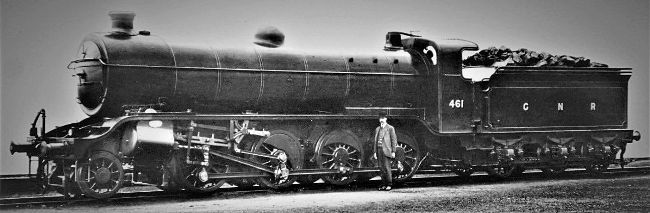
Gresley wanted to take his ‘O2’ 2-8-0 design a step further and explore the use of three cylinders equipped with a two-in-one conjugated valve gear. This concept became a trademark part of his designs for the next 20 years. Here he poses before his first locomotive, No. 461, to be so fitted. Many more 2-8-0s would follow, but it was his Pacifics that would grab headlines and make his name.
APRIL 5, 2021, marked the 80th anniversary since Herbert Nigel Gresley, arguably one of Britain’s greatest engineers, died. Although suffering from poor health which might have ended the careers of lesser men, he struggled on and died ‘in harness’.
With the Second World War at its height and Britain’s very existence in jeopardy, his strong sense of duty kept him going to the end. This helped ensure that the LNER could support the war effort and help turn potential defeat into victory.
As a man he was steadfast, determined, a strong and pragmatic leader, a scientist by nature, and an engineer of great substance. In essence, he was a polymath who developed a detailed knowledge of many subjects during his lifetime, allowing him to solve a series of complex problems that may have defeated others.
In so doing, he never lost sight of the economics and politics of big business, and the need to balance many factors in producing engineering solutions that enhanced the railway’s operation. Such was his success that his name is probably as well-known now as it was at the height of his fame.
Achievements
To ensure this remains so, we have many examples of his work around us today, such as Mallard and Flying Scotsman, plus a new ‘P2’ on the way. There is also a statue at King’s Cross which continues to attract interest.
But among all these signs of engineering prowess, many details of his life seem to have slipped from memory. So, to mark this anniversary, it is fitting to remember his life and the totality of his remarkable achievements.
Herbert Nigel Gresley was born in Edinburgh on June 19, 1876, while his mother, Joanna, was visiting the city to consult a gynaecologist, suggesting there were problems with her pregnancy.
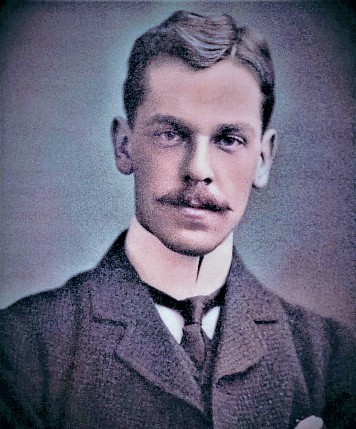
Herbert Nigel Gresley very early in his career. Following the death of his father and elder brother, who were both called Nigel, he appears to have dropped his first name in favour of theirs.
After a short period of recovery, she returned to the family home in Netherseal, Leicestershire (later Derbyshire), where her husband, the Reverend Nigel Gresley, vicar of the parish, and their other four children awaited her and the new addition. From an early age, Bertie – as his siblings called him – demonstrated a fascination with engineering and the railways, aided by his father’s love of science. This growing interest was encouraged by three years of schooling from 1890 at Marlborough College.
Due to his father’s rapidly declining health, it seems Gresley then chose to become a premium mechanical engineering apprentice with the London North Western Railway at Crewe, rather than attending university and therefore being a drain on his father’s diminishing resources. He studied under the dynamic but difficult Francis Webb, and his works manager, Henry Earl.
Having qualified in 1898, after five years of hard work, Gresley successfully applied for a post with the Lancashire and Yorkshire Railway, where John Aspinall held sway as Chief Mechanical Engineer. Over the next five years, he occupied various posts, rising in rank to become Assistant Superintendent at Newton Heath.
Such was his growing reputation that, during 1905, he was appointed to be the Great Northern Railway’s Carriage and Wagon Superintendent by Henry Ivatt –and with this significant posting the most important part of his career began.
Creative thinking
But no matter how much his training and guidance from wise men helped him develop as an engineer, these influences could only cast their spell if the individual concerned had talent and the ability to think deeply and creatively.
There is little doubt that Gresley was so imbued, demonstrating these qualities from very early in his career and continuing to do so as he rose to the top of his profession.
In the early days he gained experience of design work, his clever mind absorbing a great deal of information along the way. But he did not fully take the lead in this area of work until 1911. In that year Ivatt announced his intention of retiring, and the prospect of promotion raised its head.