PRACTICE AND PERFORMANCE
‘Two plus four’ no more
Guinness World Record: Longest-running railway series, established in 1901
John Heaton FCILT pays tribute to GWR’s 2+4 ‘Castle Class’ HST sets, which were withdrawn from regular service with the December timetable change.
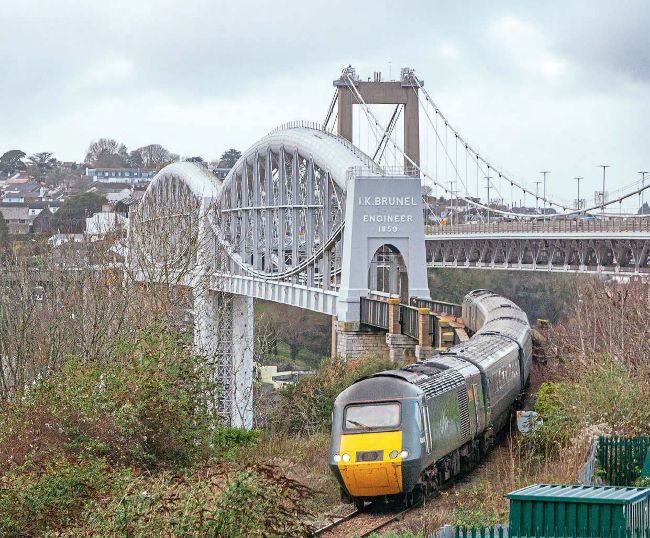
A GWR 2+4 ‘Castle’ set with power cars Nos. 43098/43187 enters Devon from Cornwall after crossing the Royal Albert Bridge on December 6 with the 11.50 Penzance to Plymouth.
JON HIRD
NO longer will the sound of Class 43 HST engines resonate across the bay from Penzance to St Michael’s Mount, as an era came to an end on December 14 when Great Western Railway finally withdrew its last IC125 set from regular service.
Perhaps the Saphos Midland Pullman (an HST in disguise) will visit occasionally, but the famous power cars that are sometimes credited with saving British Rail’s InterCity business are otherwise extinct in English passenger service. Some short formations continue to perform sterling work in Scotland, but even their days are numbered.
When a black hole appeared in the GWR DMU allocation, following delays over the introduction of new classes and subsequent planned stock cascades, there was widespread incredulity when GWR announced it was to spend vast sums on refurbishing a small fleet of power cars and make the Mk.3 coaches compliant with the latest standards, including the radical fitting of sliding doors to replace the old slam ones. Industry old lags were heard to remark that British Rail could not make 2+7 formations pay at InterCity fares, needing to stretch them to 2+8 and, subsequently on the East Coast Main Line, 2+9.
The original Valenta engines had also been unreliable, particularly in hot weather, with the resulting locomotive assistance or lost time accumulation being commonplace. Subsequent engine designs were tried with varying levels of success, but it is fair to say that it was only the adoption of MTU engines that brought the problem under control. In fact, many believe that the East Coast MTU ‘2+9s’ achieved higher speeds, for instance climbing Stoke bank towards Grantham, than previous combinations. When the old engines were still in use on 2+9s, the HSTs had to be cajoled to attain anything approaching 120mph other than downhill.
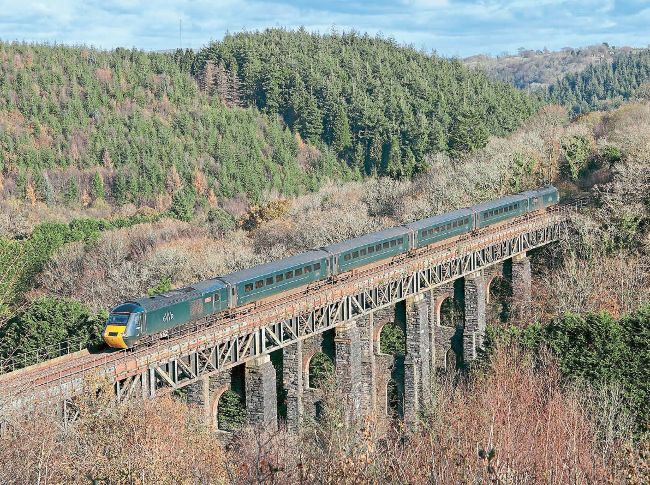
A ‘Castle’ set with power cars Nos. 43004/43156 cross Cornwall’s St Pinnock viaduct on November 17, 2025, with the 11.27 from Exeter St David’s to Penzance. No. 43004 was then the operator’s oldest power car in service.
RUSSELL AYRE
A warm welcome
West Country train timers warmly welcomed the idea of 2+4 HSTs. Surely the reformed sets would make huge improvements on existing Railway Performance Society (RPS) tables of quickest known journey times, compiled between all pairs of HST timetabled stops.