ULTIMATE GUIDE SPACE HARRIER
“ALERT! FANTASYLAND FALLS INTO CRISIS NOW.” WITH THAT MANGLED MESSAGE, THE HEROIC HARRIER RETURNS TO FACE A NEW WAVE OF INTERSTELLAR INTERLOPERS - WHILE SIMULTANEOUSLY CARRYING THE HOPES AND DREAMS OF SEGA’S NEW 16-BIT CONSOLE
WORDS BY MARTYN CARROLL
S
pace Harrier II was precisely one half of the Mega Drive’s launch line-up when it debuted in Japan in October 1988; the other was Super Thunder Blade. Such was Sega’s success in the arcade sector at the time, it had a vast reserve of titles to draw from, yet it chose to adapt two of its arcade heavyweights for one clear reason: to demonstrate that the Mega Drive was the first console to truly deliver the ‘arcade at home’ experience.
There was an issue, however. Both Space Harrier (1985) and Thunder Blade (1987) were built on Sega’s sprite-scaling technology, and the Mega Drive was good but not that good. In fact, the first arcade-perfect port of Space Harrier wouldn’t arrive until 1996 on the next-generation Saturn. So with a sleight of hand, Sega developed the games as sequels rather than conversions. This served to reduce unfavourable comparisons with the original coin-ops, while at the same time promising something fresh and exciting.
The jury’s definitely out on whether this worked for Super Thunder Blade. New minibosses were added and one of the stages was reworked, but crucially the top-down sections where you could control the chopper’s altitude (a real showcase for the sprite-scaling graphics) were removed. For Space Harrier II, 12 new stages were devised, each with new enemies and bosses, plus two remixed bonus stages where you jumped on a jet board. To achieve the 3D effect, the sprites were drawn at a variety of different sizes - typically nine variations, from small to large - to give the impression that they were zooming towards or away from you. As a result, the game lacked the silky smooth 3D movement of the coin-op, but the speed at which the sprites were cycled, coupled with the sheer number of sprites on-screen, ensured that the choppiness was quickly overlooked.
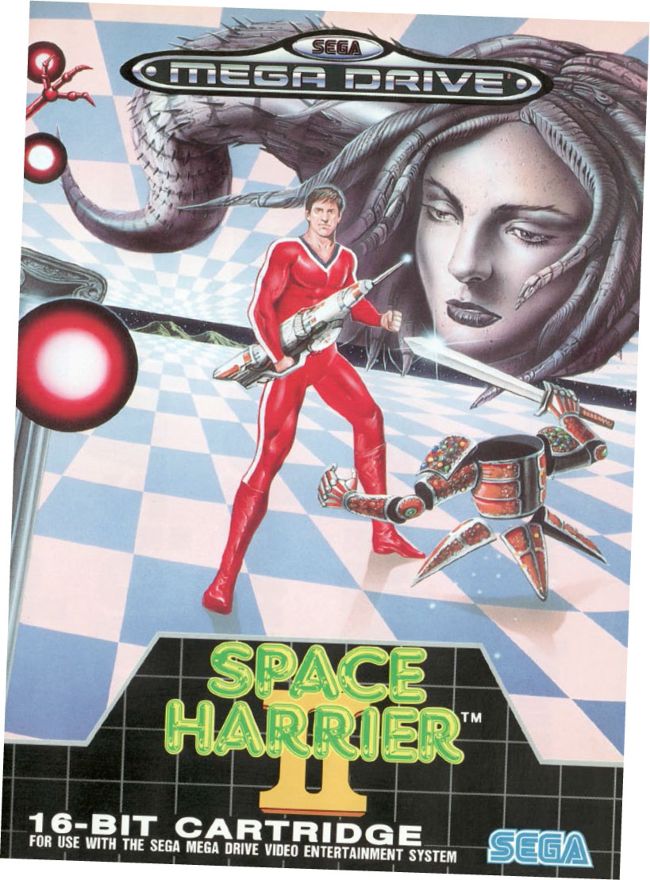
The game’s cover art was created by Sega illustrator Masashi Iwasaki.
The technical limitations also resulted in more creative and varied boss battles. Most of the original game’s bosses were simply giant beasties that filled the screen, whereas in the sequel their visual impact was lessened so they had to work harder to impress. New guardians like Medusa, Paranoia and Mantichora made for more challenging showdowns. In a neat touch, Squilla, the dragon boss from the coin-op’s opening stage, returned in the sequel - but was demoted to a miniboss that appeared before new monster Trimuller.