CAPCOM AN ARCADE LEGACY
MANY COMPANIES HAVE MADE THEIR MARK IN THE ARCADE, BUT FEW HAVE BEEN SO INTEGRAL TO GAMING’S OLDEST SCENE AS CAPCOM. JOIN US AS WE DISCUSS A LEGACY OF SUBLIME SHOOTERS, BOISTEROUS BEAT-’EM-UPS AND OF COURSE, VERSUS FIGHTING GAMES
WORDS BY NICK THORPE & MARTYN CARROLL
Here’s a mental exercise for you: picture your favourite arcade, any time from the late Eighties onwards. Think about the games in it. How long did it take before a Capcom game crossed your mind? We can’t imagine it was long – the company was a dominant force during the heyday of the coin-ops. You could have imagined 1942 neatly tucked into a seaside arcade, Final Fight at the swimming pool, Strider hiding in the corner of the local pub or even Capcom Vs SNK freshly installed in a gigantic projection screen cabinet. Then of course there’s Street Fighter II: The World Warrior, a game so popular that it can be said to have single-handedly revitalised the Nineties arcade scene. When you think about arcades, it’s impossible to ignore Capcom.
Capcom’s roots go back to a company called IRM Corporation, a company that was set up to develop and sell electronic gaming machines, founded in 1979 by Kenzo Tsujimoto. As a seasoned Osaka-based entrepreneur, Tsujimoto was experienced in the field as he was also the chairman of Irem Corporation, another amusement machine manufacturer that had just entered the videogames market. However, Irem was acquired in 1980 by electronics manufacturer Nanao, and within a couple of years Tsujimoto was out of favour with the new owners. In 1981, IRM became Sanbi and Japan Capsule Computer was established, providing the two words that would give Capcom its name in 1983. Capcom’s early products were mechanical games, Little League and Fever Chance, but by December of that year it had opened the Acty 24 video arcade and in May of 1984 it released its first videogame, Vulgus. This shoot-’em-up would find distribution in North America via another Osaka-based arcade company, SNK.

Before the end of 1984, Capcom would release three more games. Pirate Ship Higemaru and SonSon were both fun games, but it was the December release of 1942 that really showed the way for the company’s early years. Like Vulgus, 1942 was a vertically scrolling shoot-’em-up, but this time the theme was World War II. YouTuber and shoot-’em-up enthusiast Gmintyfresh remembers it as the first Capcom game he ever saw. “I was blown away after my first play by the difference between this and the previous shooters I had played like Space Invaders and Galaga, there was something special about the varied gameplay, fully fledged power-up system, and beautiful bold sprites which drew me in.”
CAPCOM
STAFF FAVOURITES
TAIROKU NOZOE
Pir ate Ship Higemaru
The gameplay is simple yet deep and endlessly replayable. The nautically themed pixel-art characters, items and icons are so cute and colourful and I love both the gameplay and atmosphere of the game. Please give it a try!
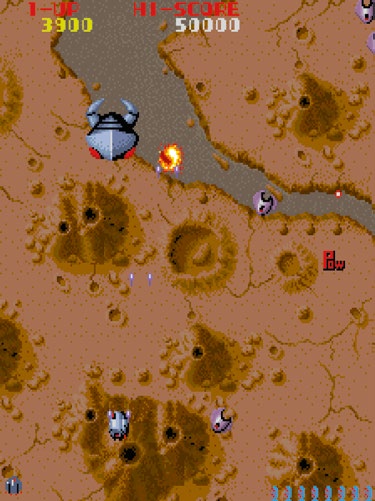
» [Arcade] Vulgus showed early signs of Capcom’s key qualities, including attractive art and shoot-’em-up prowess.
CAPCOM
STAFF FAVOURITES
TAKASHI ISHIHARA
Street Fighter II Turbo: Hyper Fighting
To my younger self, this was more than just a game. A person’s value was their skill at Street Fighter II. Their Street Fighter II skill was them. Compared to modern fighting games it may seem simplistic, but the skill it demanded of players was the real thing. It was the kind of game that made people as serious about it as I am. Within the Street Fighter II series, Turbo features high-speed gameplay balanced with reduced attack power, which made for thrilling back-and-forth fights.
ALEX TROWERS
GAME DESIGNER
DANNY BURKE
GAME DEVELOPER
NIC MAKIN
GAME DEVELOPER
BEN JONES
PRODUCT MANAGER, CAPCOM HOME ARCADE
PAUL DAVIES
FORMER CVG EDITOR
GMINTYFRESH
SHOOT-’EM-UP ENTHUSIAST AND YOUTUBER (GMINTYFRESH)
DIMITRIS GIANNAKIS
CPS COLLECTOR AND YOUTUBER (MODERN VINTAGE GAMER)
DOSBOXFALCO
CHAMPION SPEEDRUNNER
CAPCOM
STAFF FAVOURITES
TAKASHI MATSUDA
Street Fighter II: The World Warrior
This game brings back bittersweet memories of youth for me! It became the basis for the versus fighting game genre, and the great thing about it was how differently each of the playable characters looked and controlled. Each required a different strategy and I think that’s why people got so intensely involved in their matches. I not only enjoyed playing the game, but watching more skilled players than myself play while I waited for my turn…
Game designer Alex Trowers first encountered the game at a pub in Hambledon, and quickly became a fan. “Nowadays, I can look at it with a more designcentric critical eye and one of the things that stands out is the fact that it’s not about muscle memory,” he tells us. “There are certain patterns, sure, but they’re always modulated by your positioning so it’s never the same game twice. Also the limitation of three player shots can be gamed – getting close to a target to increase your fire rate and damage output – increasing the skill ceiling.” This depth ensured that the game had plenty of staying power in Japan, and stuck around the top ten in Game Machine magazine’s ranking of Japan’s best performing tabletop arcade games for over nine months in 1985. At the end of that year, the Famicom version of 1942 would launch Capcom into the home gaming market, where it would often extend the life of its arcade hits.
FRANCHISE STARTERS
THE GAMES ON WHICH GREATNESS WAS BUILT
1942
YEAR: 1984
Not Capcom’s first videogame, but the one that helped establish it as an arcade force. 1942’s popularity led to a slew of sequels – the majestic 19XX series – which built on the WWII shooter template. The original may look primitive in comparison but it’s still a blast.
COMMANDO
YEAR: 1985
The game that intro duc ed us to gun-toting, grenade -flinging Super Joe – and the unbridle d joy of single-handedly blowing away an entire enemy army. It had two sequels, Mercs (1990) and Wolf Of The Battlefield: Comma ndo 3 (2008), a wild west spin-off, Gun. Smoke, and a host of imita tors.
GHOSTS ’N GOBLINS
YEAR: 1985
Lance drawn, Sir Arthur descended into the Demon World for the first time – and did die, over and over. It was challenging, but as compelling as hell. A series was born, starting with the sublime Ghouls ’N Ghosts, and there were a couple of spin-off series in Gargoyle’s Quest and Maximo.
BIONIC COMMANDO
YEAR: 1987
This run-and -gun platformer was lifted above the competition thanks to its swing mechanic that saw hero Rad Spencer scale the game’s dizzying stages. The Rearmed updates would appear belatedly, plus a 3D reboot in 2009, but it’s the Nineties Game Boy spin-offs that deserve attention.
STREET FIGHTER
YEAR: 1987
Has a game ever been so overshadowed by its successor as Street Fighter? Even Capcom ignored the original for years, before finally including it on compila tions. Regardless, this is where Ryu hurled his first Hadouken, and Ken, Sagat, Adon, Gen and other combata nts made their debuts.