STEVE MERETZKY
Infocom was a pioneer of the text adventure, and among its talented designers – ‘Implementers’ – was Steve Meretzky. From working with Douglas Adams to the minefield of mobile gaming, he looks back on his lengthy career
Words by Andrew Fisher
Comedy played a key role in Steve’s games, so what shaped his sense of humour? “Many things. Certainly, Warner Brothers cartoons, which were a Saturday morning staple in our household. Monty Python. Early Woody Allen. Saturday Night Live. Just to name a few,” says Steve. He took quite a circuitous route to becoming a game designer, having gone to the Massachusetts Institute Of Technology (MIT) to study architecture (with a minor in creative writing, which would come in handy). After his years at Infocom, Steve became a consultant and worked freelance with other publishers before founding Boffo Games. A string of bad luck led him into casual gaming, but he can look back on many fondly remembered titles.
How did you end up testing games for Infocom?
I was involved in the movie and lecture group at MIT (the Lecture Series Committee), where I became friends with many of the initial founders of Infocom. After graduation, I was working for a construction company, and not enjoying it. I was sharing an apartment with Mike Dornbrook, Infocom’s sole game tester. When Mike went off to Chicago to go to business school, Marc Blank needed a new tester, so he chose the next best person in our apartment, which was me.
How long did it take to go from tester to Imp (Implementer) while you were there?
About a year, though it was a gradual transition. My first work for Infocom was testing Deadline in November of ’81. I started writing Planetfall around September of ’82, but I kept testing games throughout most of the time that I was writing Planetfall (which was released in the fall of ’93).
What inspired your first game Planetfall, and its legendary robot Floyd?
There had been characters in Infocom games before… the thief in Zork I, the wizard in Zork II, the many suspects in Deadline. But there hadn’t been much focus on a single ‘sidekick’ character. I thought that, with such a focus, the character could be a little deeper and more interesting. Beyond that, I was also most interested in science fiction as a genre, and Dave Lebling’s Starcross (at that point, Infocom’s only science fiction title) had been my favourite Infocom game to date.
You created the second game in the Enchanter trilogy, Sorcerer. Did it feel different creating a more traditional fantasy adventure game?
A game with magic is pretty liberating, since magic can do pretty much whatever you want it to do, and it doesn’t have to make sense… it’s magic! Beyond that, not too different. And it was a sequel, so there was a lot less world-building needed than when I created Planetfall.
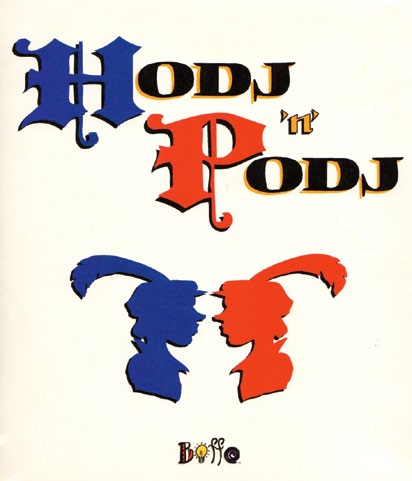
» The superior Hodj ‘N ’ Podj cover that was never used.
Was there much collaboration and co-operation between the Imps?
Oh yes, quite a bit. We all played each other’s games at a fairly early stage and gave lots of feedback. And we met weekly for an ‘Imp’s lunch’ where we’d talk through any problems anyone was having.
When did you learn you would be working with Douglas Adams on Hitchhiker’s?
It was probably toward the end of my time on Sorcerer, as I was wrapping up the game. Probably late January or early February of 1984. Douglas was most interested in collaborating with Marc Blank, as the head Imp, but he wasn’t interested, for whatever reason. He asked me, because I was just about to get freed up, and perhaps because Planetfall was the most Hitchhiker’s-like of the Infocom games so far, and I said sure.
What was the working process like?
In February of ’84, he came over to Massachusetts for a week, and we got the first part of the game done (through the arrival on the Vogon ship). Then he went back, and we were going to communicate via an early (pre-internet) version of email, requiring lots of fiddling with modems and other annoying stuff. But Douglas was a serious procrastinator (on all his projects, not just the Hitchhiker’s game), and we’d made little progress by May. It was getting to the point that releasing the game in time for the Christmas ’84 selling season was in danger.