Ultimate Guide: Puzznic
WHEN TILE-MATCHING GAMES WERE TEN A PENNY, TAITO RELEASED ONE OF THE MOST COMPULSIVE AND CEREBRAL COIN-OPS OF ITS TYPE. JOIN US AS WE GET FRANTIC WITH PUZZNIC – AND UNCOVER ITS UNEXPECTED SLEAZY HISTORY
WORDS BY MARTYN CARROLL
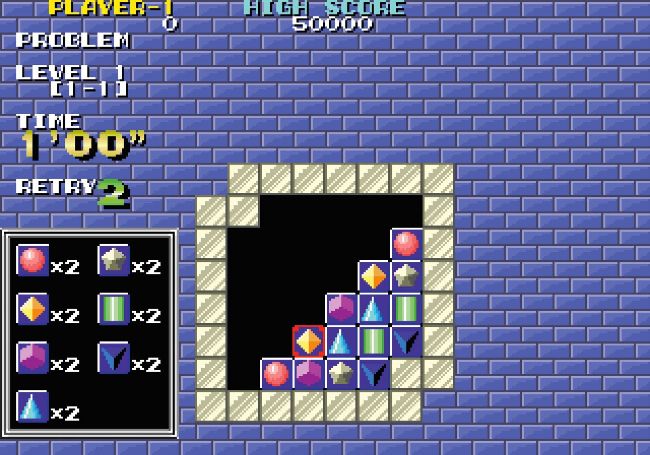
» [Arcade] Many of the early stages simply involve matching pairs as quickly as possible.
N othingwas impervious to the Tetris effect. Having escaped its Russian homeland in the late-Eighties, Alexey Pajitnov’s puzzle game and its falling blocks were suddenly everywhere – on computers, consoles, even in our dreams.
Tetris was a huge hit in arcades too, with both Atari and Sega producing coin-op versions thanks to the famously muddled rights process. And with success came the clones, including Block Hole from Konami, Block Out from Technos and Puzzled from SNK. Even (quasi) official rights’ holders Atari and Sega created their own spins on the puzzle genre in Klax and Columns. Taito’s response to the Tetris effect was the three Ps: Plotting, Puzznic and Palamedes.
"PUZZNIC OFFERED A SMARTER, MORE COMPOSED TAKE ON THE TILE-MATCHING FORMULA”
In both Plotting (1989) and Palamedes (1990) you cleared screens by flinging matching tiles at each other. Tucked between these releases was Puzznic which offered a smarter, more composed take on the tile-matching formula. Each ‘problem’ featured up to eight block types which were under your direct control and could be moved freely around the screen (although gravity was present, so blocks would fall if not supported). By matching blocks of the same type they’d disappear – simple, except that most puzzles featured an odd number of block types. This meant that you needed to orchestrate matters so that a trio of the same type touched simultaneously, otherwise you’d be left with a rogue block that you couldn’t remove from play and have to start over. Sometimes you’d have to build bridges and towers to bring certain blocks together, while ensuring that in doing so you didn’t accidentally remove blocks that were required elsewhere. And obviously while you were sweating over the correct completion sequence, the timer was counting down in the corner. Brutally, if you buggered up a puzzle and had to restart (you were given two retries per credit), the timer carried on ticking away regardless. This was no casual game.
PYRAMID BLUE
CONE BLUE
FUNNEL GREEN
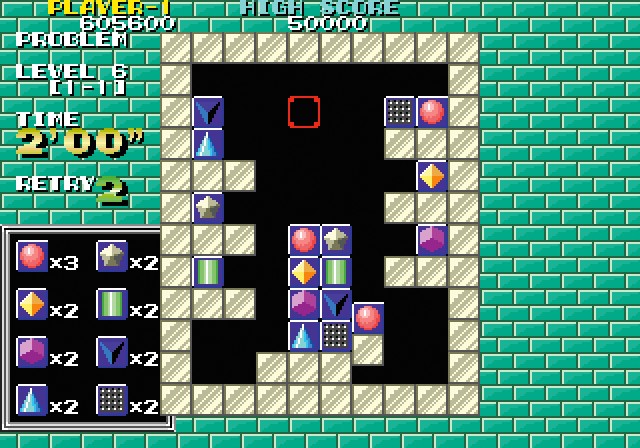
[Arcade] Later puzzles regularly feature all eight block types which you need to clear.
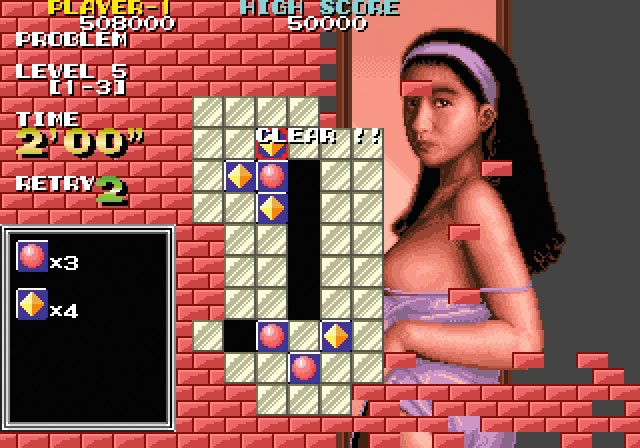
[Arcade] In the Japanese and US versions, the more puzzles you clear, the more you get to see models like Tracie.
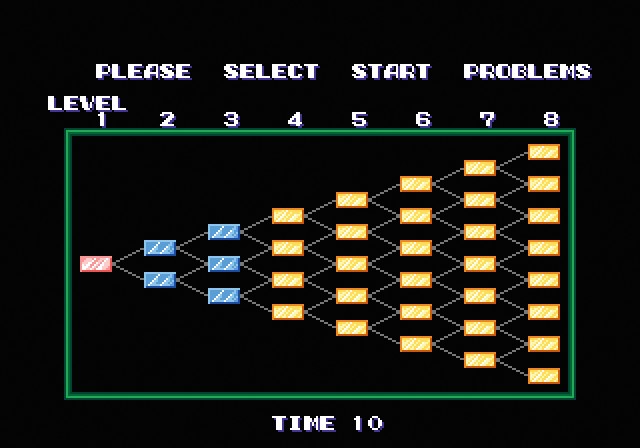
[Arcade] Puzznic features 36 areas, but the branching structure means you only have to complete eight of them.