INSIDE THE ATARI 2600
ATARI’S SEVENTIES CONSOLE MIGHT HAVE BEEN A SMASH HIT WITH PLAYERS, BUT ITS UNIQUE HARDWARE AND SEVERE LIMITATIONS POSED A NOTORIOUSLY TRICKY CHALLENGE FOR DEVELOPERS. WE SPEAK TO CODERS PAST AND PRESENT TO EXPLAIN JUST HOW THE SYSTEM WORKS
WORDS BY NICK THORPE
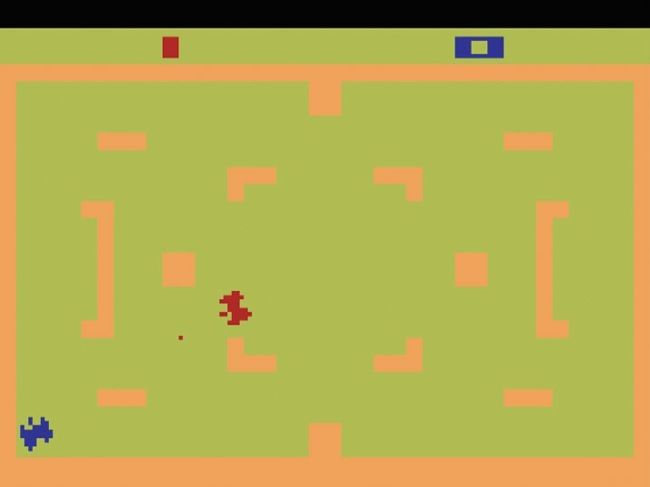
» [Atari 2600] Combat is the Atari 2600 used as intended, and looks exceptionally basic compared to later games.
True revolutions in the field of gameconsole engineering are a rarity, but there’s no doubt that the Atari 2600 fits the bill. The earliest home consoles had been dedicated Pong consoles and similar devices, which were designed to play only the games that they were built for, with no capability for expansion. The Atari 2600 was a completely different proposition, with its use of a programmable CPU and ROM cartridges allowing for a theoretically unlimited number of games. Though Atari’s console wasn’t the first to offer this capability – the Fairchild Channel F claimed that distinction in 1976 – it did popularise the concept, selling millions of units and setting the standard for how future gaming hardware worked.
The concept for such a console originated at Atari’s subsidiary Cyan Engineering, but the hardware required to create it as a consumer product didn’t become affordable until the mid-Seventies. In September 1975, a team at MOS Technology headed by former Motorola engineer Chuck Peddle introduced the affordable 6502
CPU, which cost just $25 ($143, adjusted for inflation). As well as being more affordable than competing processors from Intel and Motorola, which had been introduced at $360 each ($2,060 today), it was more capable. However, even at $25 the 6502 was too expensive for a home console, and Atari ultimately negotiated for the cost-reduced variant 6507 CPU and 6532 RIOT chips at $12 a pair.
The graphics hardware, originally codenamed Stella after Joe Decuir’s bike, was also developed at Cyan. Jay Miner ultimately finished this while Joe Decuir worked on the rest of the system, and it was named the Television Interface Adapter. Due to the high price of RAM – $195 ($1,116 today) for four kilobytes in October 1975 – this chip doesn’t include a framebuffer, which is memory that graphics are typically written to before being drawn to the screen. This allowed for a high level of flexibility, but also placed a major burden on programmers. The Atari 2600 launched in September 1977, at a price of $199 ($1,011 today).
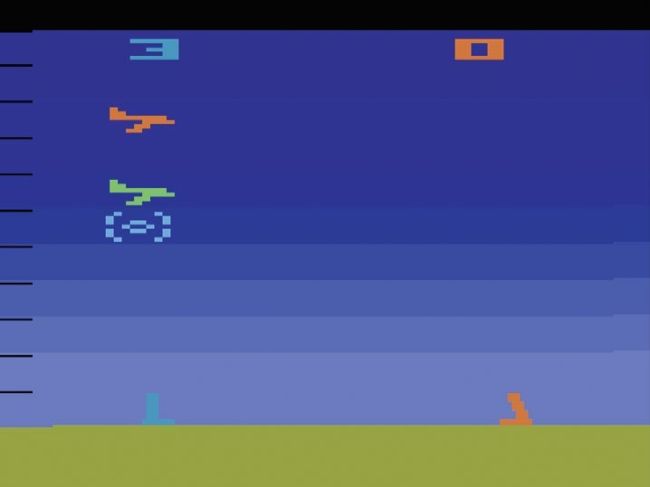
» [Atari 2600] The trick of reusing player sprites was in use as early as Air Sea Battle.
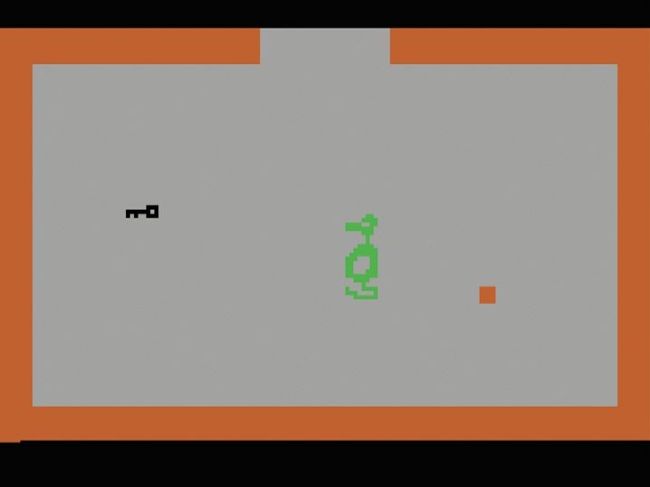
» [Atari 2600] Graphics on the console sometimes had to be rather abstract, as Adventure’s dragon shows.
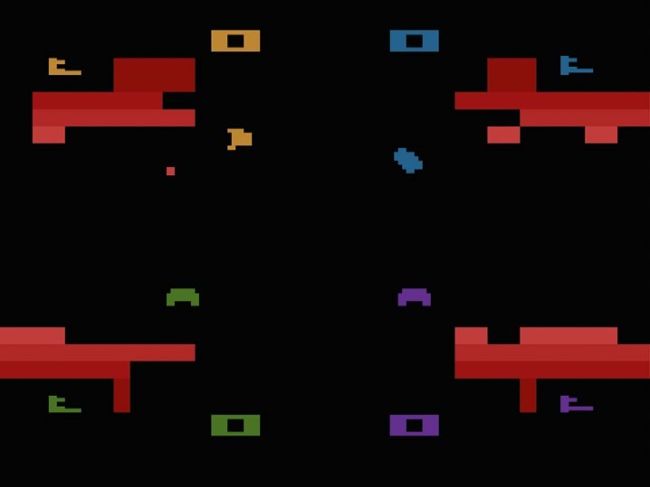
» [Atari 2600] The fact that Warlords handles up to three computer players is a minor miracle.
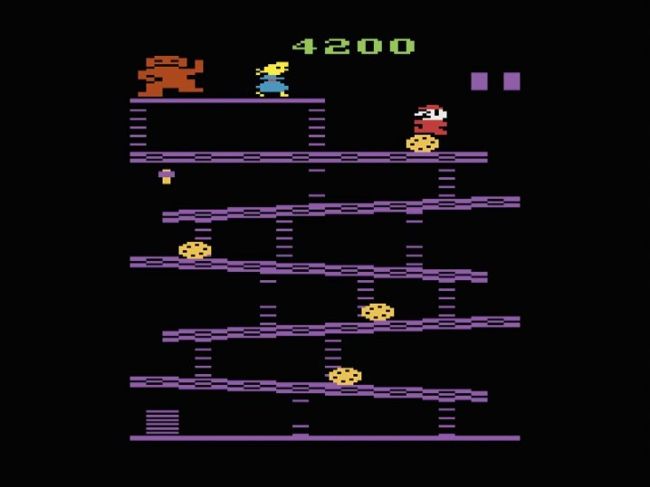
» [Atari 2600] Donkey Kong’s asymmetrical girder layout requires rewriting playfield data mid-scanline.
What did the design decisions mean in practical terms? “The 6507 was in a smaller IC package that cost a little less. It still had a full 6502 die inside, but there weren’t enough pins to bring all of the lines of the 6502 to the outside world,” says David Crane, whose Atari 2600 games include Pitfall!, Outlaw and Circus Convoy. “Three of the lines they left disconnected were address lines that allowed the 6502 to address 64KB of memory. Abandoning those address lines limited the 6507 to access 4KB in the ROM slot. The designers of the 2600 never planned on ROMs bigger than 4KB, so it seemed to be no big deal.” Indeed, the earliest games such as Combat and Indy 500 shipped on 2KB ROM chips. “It became a problem as games needed larger ROMs, leading to more and more complex bank-switching schemes to allow 8K and larger games,” David recalls.
Bob Polaro, programmer of games such as Defender, Road Runner and Rampage, remembers the development tools used at Atari. “Along with downloading to a 2600 connected to a TV, there was the HP 1611A Logic Analyzer and DEC PDP-11 console station,” he says. For debugging, “the Logic Analyzer was the most useful tool, which would display the cycles used as well as a specific hardware register’s value.” Steve Cartwright, who programmed games such as Barnstorming, Frostbite and Megamania, remembers a similar environment. “At Activision we used a custom-built hardware emulator connected to a modified 2600. Software was a custombuilt assembly language assembler and debugger. We used ADM3A dumb terminals connected to a PDP-11.”
What was the hardware emulator connected to the console? “The simplest way to develop a game for any ROM-based game console was to use a ROM Emulator, which could be wired to the cartridge slot as if it was a ROM in a plastic cartridge. We would occasionally use this commercially available technology when we started working on a new console,” says David. “Then, as quickly as we could, we would make a development system, or blue box, specifically for the system. This meant designing a custom circuit and circuit board. I made many such systems over the years and usually used a modular aluminium project box as an enclosure. The brand I used had blue powder-coated metal parts which is where the term ‘blue box’ came from,” he continues. “The blue box I designed at Activision for the Atari 2600 connected to the cartridge slot, but with RAM directly wired into the CPU’s address space. The RAM still pretended to be the cartridge but it was more easily uploaded with test code and also allowed for special debugging tools.”