Mauser’s Claw: Myth or Magic?
Controlled Feed and a Mighty Tug on Stubborn Cases
Wayne van Zwoll
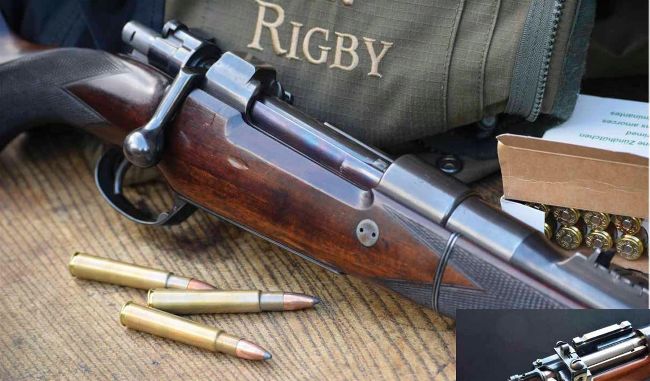
The Magnum Mauser action welcomed Rigby’s 350 Magnum, introduced in 1908. Rigby and Mauser had a trade agreement before World War I. Rigby still uses Mauser actions for its fine bolt rifles.
“Shoot!” Not that it was my call, but Alan’s buffalo was suddenly a shared project. It had come from the side, fast through thin grass, screened by thorn a barrel-length away. Forty yards. Thirty-now-twenty!
The 375 bellowed. Its chest centered; the animal missed a step. Then on it came. Alan’s follow-ups and cracking limbs echoed faintly as my 9.3 bucked twice, the beast now turning, stumbling…
The Model 70 and the Mauser licked cartridges and spewed hulls as fast as we could cycle their bolts – bolts developed 130 years ago.
Many hunters recognize Peter Paul Mauser’s non-rotating extractor as a defining feature of his 1898 bolt action. Actually, that long extractor spring, held to the bolt body by a collar, first appeared on his Model of 1892. Lifted by the magazine’s follower into an open breech, the rim of the top cartridge in the stack rose into the claw from underneath before the cartridge aligned with the barrel. The bottom of the bolt face was milled flush with its center so the case head slid naturally into place. In the military ’98 and commercial Mausers, that claw grabs about 20 percent of the case rim. The extractor spring pushes it into the cartridge’s extractor groove, snugging the cartridge against the bolt face. The extractor’s tongue is undercut to ensure a bulldog grip during extraction. That grip empties hot, dirty chambers and clears the breech even if, in the press of battle or a tense moment afield, the shooter short-cycles. The claw holds on if the rifle is tipped or jarred during cycling. The bolt can’t accept a fresh cartridge until it dumps the first. No double loading, no jams. No spill of a live cartridge or early release of a hull.
Bracketing the ejector groove on a 98 bolt face are two cartridge support lugs. The lower of these is angled to guide each round as the magazine spring pushes it up. This lug matters because the Mauser’s staggered cartridge stack is not funneled at the top into a single column that feeds into the action’s center. Positioned on the bolt face, the case head is supported by both lugs. The angle and bearing surface of the lower lug determine how easily a cartridge crosses the bolt face, yields to the extractor and stays centered as the bolt slides into battery.
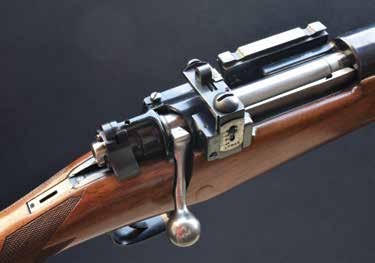
Jack O’Connor used his custom-built ’98 in 450 Watts on Cape buffalo. Clearly Mauser’s extractor.
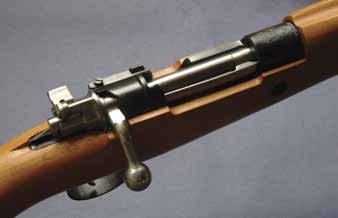
Vintage 1898: the non-rotating extractor and collar – as well as clip and thumb slots, flag safety, bolt and release.
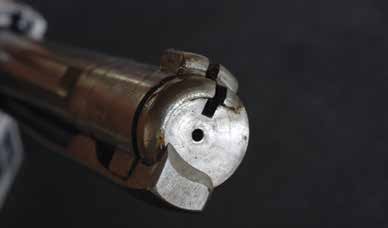
Mauser slotted the left lug for the ejector. The leading edge of the beefy extractor claw is gently curved.