Rock Science
DEVILS TOWER
BY STEVE VOYNICK
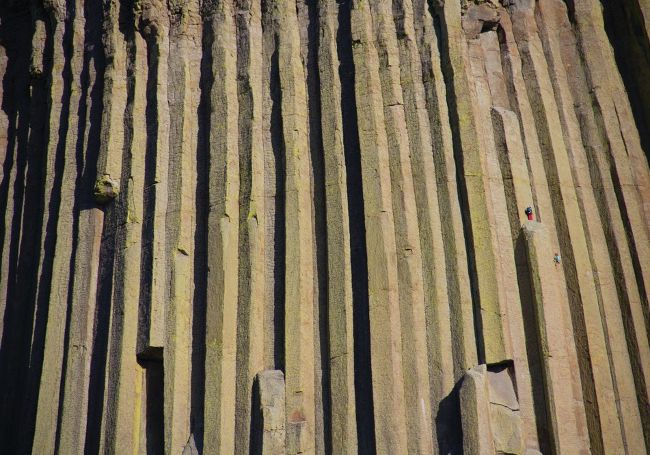
Near right: A close-up look at the vertical columnar jointing that is the most distinguishing feature of Devils Tower.
(Wikimedia Commons)

Far right: Lakota Chief Arvol Looking Horse is among the Native Americans who return to Devils Tower each year.
(National Park Service)
A 1977 movie premiere in New York City profoundly affected visitation at a small national monument 1,600 miles to the west. The movie was Steven Spielberg’s UFO-thriller Close Encounters of the Third Kind; the national monument was Devils Tower in remote northeastern Wyoming. In the movie’s dramatic climax, Devils Tower, a huge stone monolith and geological curiosity, became the landing site of extraterrestrial beings.
Close Encounters
made a huge impression on its audiences. In just the next few years, Devils Tower National Monument hosted nearly as many visitors as it had during its entire 70-year history. While visitors did not—as far as we know—encounter any extraterrestrials, they did discover some remarkable geology and rich Native American lore.
GEOLOGY
Geologists describe Devils Tower as an isolated, exposed remnant of a laccolithic intrusion. It is a body of igneous rock that is, oddly enough, surrounded by sedimentary formations of sandstone, siltstone and shale.