Burmese JADE
THE STORY OF MYANMAR’S JADEITE
STORY BY STEVE VOYNICK
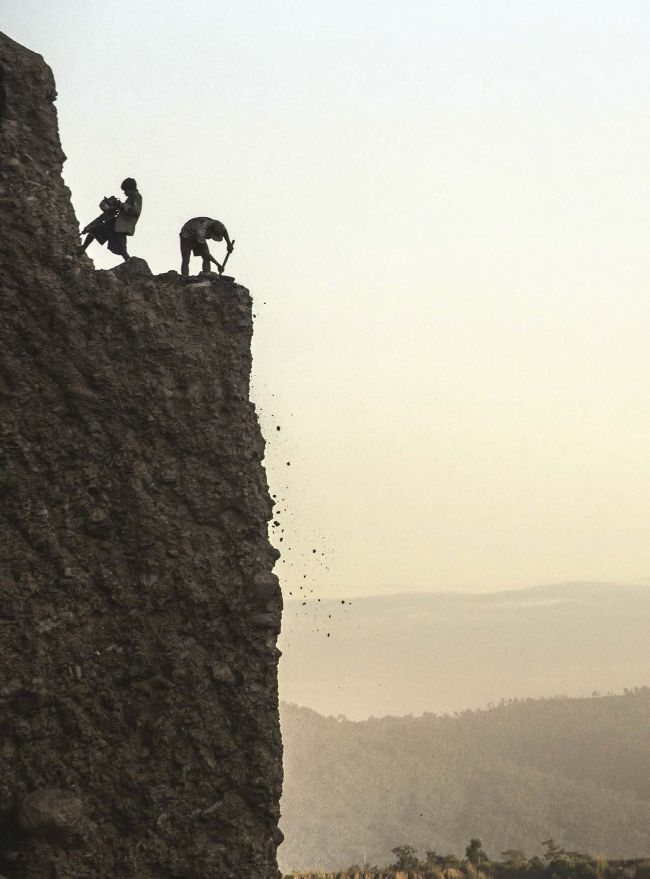
Artisanal miners work atop a vertical, openpit mine wall in the Hpakan Jade Tract.
ALL PHOTOS COURTESY WIKIMEDIA COMMONS
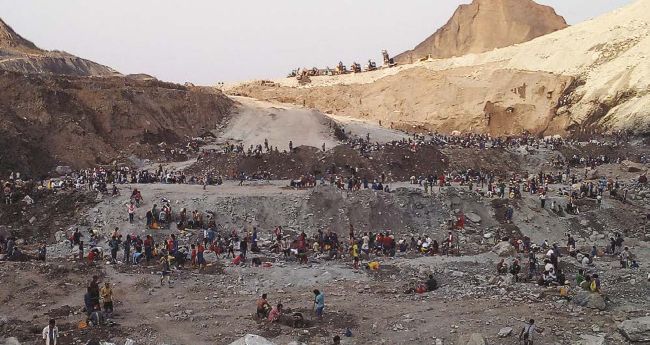
Hundreds of unlicensed, artisanal miners search a Hpakan mine dump for pieces of jadeite.
In the 1990s, Richard Hughes was one of the first western gemologists and authors to visit Myanmar in three decades. After touring that nation’s jade mines and markets, he described the jade trade as “… a spin of the roulette wheel.
Some will win, more still will lose.”
Since that time, the production and prices of Myanmar’s jade have soared to record highs. But one thing has not changed: just as Hughes noted, that nation’s jade trade still has only a few winners and many more losers.
The Hpakan region of the southeastern Asian nation of Myanmar (formerly Burma) produces the world’s finest jade. “Burmese jade,” the traditional name preferred by the gem trade, is known for its exquisite colors, translucency, and fvine grain that are unmatched by jade from any other source.
Finished pieces of the finest Burmese jade now sell for thousands of dollars per gram, and recent mine recoveries have made international headlines.
In 2015, a Hpakan mine discovered a 200-ton jade boulder worth $17 million. Two years later, miners found a 50-ton jade boulder worth $3 million.
Despite their remarkable sizes and values, these two finds represent only a tiny fraction of Myanmar’s annual, multi-billion-dollar jade production.
The dark side of the story of Burmese jade, however, is one of rampant government corruption, environmentally disastrous open-pit mining operations, huge profits reaped only by a few wealthy mine owners, and thousands of artisanal miners trapped in an endless cycle of poverty, drug abuse, and dangerous labor.
UNDERSTANDING THE MINERALS OF THE JADE GEM
The gemological term “jade” pertains to two distinct minerals: jadeite and nephrite. The pyroxene mineral jadeite is a sodium aluminum iron silicate; nephrite, a basic calcium magnesium iron silicate, is a member of the actinolite-tremolite series of amphibole minerals.
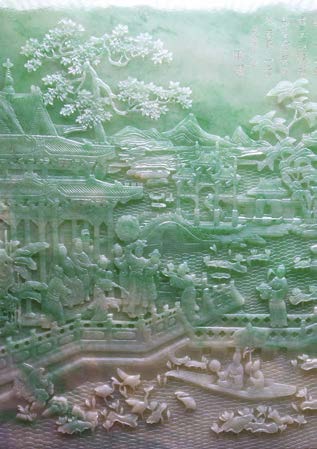
Dating to the early 1800s, this 20-inch-tall table screen was carved from a single piece of Burmese jadeite.
As metamorphic minerals, jadeite and nephrite occur at subduction zones near convergent tectonic-plate boundaries. But because of differing pressure origins, they are not found together. Neither occurs pure. Both jadeite jade and nephrite jade are technically rocks. Jadeite jade consists primarily of the mineral jadeite, along with lesser amounts of albite, tremolite, aegerine, and augite. Nephrite consists mainly of intermediate members of the actinolite-tremolite series.