SPACE: 1999
WHERE DARED EAGLES
NEVER MIND THE COMMLOCKS AS WE RETURN TO MOONBASE ALPHA TO CELEBRATE 50 YEARS OF SPACE: 1999, THE COLDEST, STRANGEST ANDERSON SHOW OF ALL
WORDS: NICK SETCHFIELD
IT’S 1975 AND THE MOON, go-to destination of the space age, so recently conquered by the Apollo missions, is about to be torn from orbit by the power of television.
A chilly, unsettling, frequently surreal watch, Space: 1999 had a premise as bleak as any lunar landscape. Opening episode “Breakaway” details the catastrophe that serves as the show’s inciting incident: on 13 September 1999 nuclear waste stashed on the far side of the Moon erupts in a massive thermonuclear explosion, sending Earth’s lone satellite hurtling to the stars. Naturally it’s a Monday.
Along for the ride are the crew of Moonbase Alpha, a scientific research station nestled in a crater in the northern hemisphere. As the wayward Moon bagatelles through wormholes and hyperspatial byways, our beige-clad heroes discover a universe more colourful than they ever imagined, and all to a theme tune packing the funkiest wah-wah guitar this side of Shaft.
It was a series with ambition to spare – and a budget to match, given that it was reportedly the most expensive production in British TV history at that point. The final offering from the vibrant, prolific partnership between Gerry and Sylvia Anderson, Space: 1999 had its roots in an abortive second season of UFO, one that would have abandoned Earth to focus on the SHADO moonbase that served as the first line of defence against alien invaders.
“They had storylines and were certainly into set design and artwork,” says Jamie Anderson, son of Gerry and managing director of Anderson Entertainment, revealing how far into development this unmade sequel season had gone. “They weren’t building anything yet, but I guess they had a fairly clear idea of where they wanted to go. I suspect bigger, bolder and better were the themes of the day.
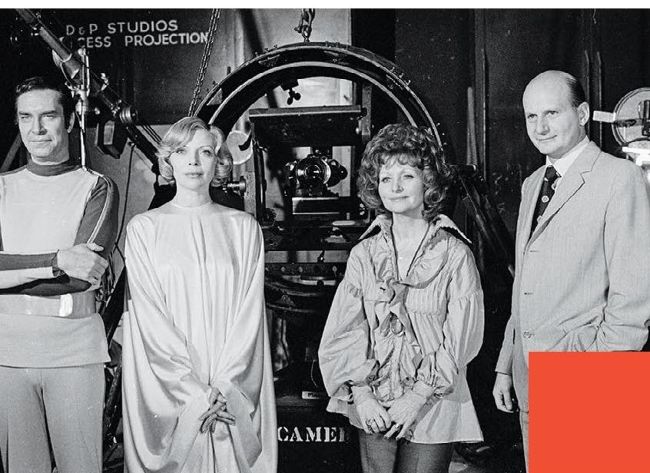
The Andersons with Martin Landau and Barbara Bain.
“Dad was very good at rescuing material. He would find a way to preserve the best stuff, the most exciting stuff. I get the impression that by this stage there was a certain amount of desperation. Dad had wanted to work in slive-action for his entire life [UFO was the Andersons’ first shot at a live-action series after they had made their names with Supermarionation] and it must have felt like ‘It’s all about to be ripped away from me, unless I can find a way to make this work!’