DEVIALET PHANTOM REACTOR
from £990 / devialet.com
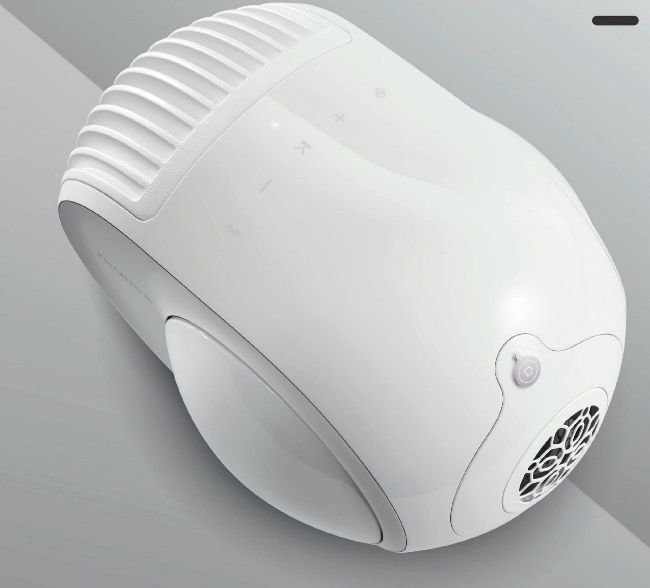
CONTROL THE PHANTOM WIRELESSLY OR VIA THE BUTTONS ON THE CHASSIS
Er, is that thing nuclear?
We haven’t turned it all the way up yet, but based on how loud its elder brother was able to go, it could well be. Devialet’s Phantom Reactor is a smaller version of 2010’s Phantom – an extremely powerful wireless speaker. The Phantom Reactor is a quarter of the size of its predecessor, small enough to be held in one hand, but if you plump for the more expensive 900W model it packs just 25% less power. If you think that might annoy the neighbours a bit, there’s also a 600W version.
Which is half as much power as the old Phantom, right?
Good maths. Want some more numbers? Both versions weigh 4.3kg, which is just over a third of the original. They have one fullrange driver and two bass drivers each, all of which are made from aluminium, and their frequency range is an impressive 18Hz to 21kHz, so you should get nice, deep, rumbly bass and crystalline treble. When it comes to pumping up the volume, the 900W version can manage 98dB SPL, while the 600W model can hit 95 – slightly louder than the engine of a lorry from 10 metres away. Bored of numbers yet? It basically means they’ll go nice and loud but have the chops to keep it clean.
But where do I plug in my iPod?
The Reactor has analogue and optical connections, and there’s also an Ethernet port – so if you want hi-res audio it works with UPnP streaming devices – but it’s really designed for wireless streaming. With support for regular Bluetooth, AirPlay (not AirPlay 2 yet) and Spotify Connect on board, you’re most likely to control it from your phone or tablet.
Nokia on heaven’s door NOKIA 7.1
Things are getting a bit crowded in the mid-range smartphone space, but the Nokia 7.1 should be able to barge its way to a comfortable seat. It looks slick for starters, thanks to the anodised metal finish and alluring accents of the Gloss Steel model. Admittedly, you’ll have to live with a notch and a chin, but this is still a premium handset for the price. The 5.84in 1080p LCD display supports HDR10 and can upscale SDR video content to HDR-like levels, while shutterbugs will appreciate the pro camera mode that makes the most of the dual snappers. Being an Android One phone, it won’t lump you with bloatware, and a Snapdragon 636 should be fine for app-hopping the day away. £299 / nokia.com
Leather forecast HP SPECTRE FOLIO
Dressing your gadgets up in a nice leather jacket is nothing new, but there’ll be no need to do that with HP’s outrageously plush Spectre Folio – it’s made of the stuff. Billed by its maker as the world’s first leather convertible PC, it really does look the part in any of its three positions: laptop, tent and tablet. And innovative design isn’t all the 13.3in Spectre Folio is bringing to the table. HP reckons it houses one of the smallest motherboards out there, and there’s an eighth-gen Intel Core i7 processor, 8GB of RAM and up to 2TB of SSD storage. Bang & Olufsen tuned the four front-firing speakers, and the battery lasts up to 19 hours. The Full HD panel will be joined by a 4K option later in the year. £1499 / store.hp.com
? WTF IS OCULUS QUEST?
Oculus Quest? Sounds like a cancelled Channel 4 game show.
Maybe, but no. Oculus Quest represents Facebook’s biggest shake-up of virtual reality since, well, the Oculus Go. While that headset introduced us to wireless, faff-free VR that doesn’t require a smartphone or crazy-powerful PC in tandem, Oculus Quest has Zuckerberg and co taking the idea a step further. It’s still entirely standalone, but now you have six-degrees-of-freedom movement tracking, so you can stand up and move inside the virtual space.
So it’s better for gaming, then?
Much. Oculus Go was a perfectly decent entry-level VR headset, but it was a bit too restrictive to be seen as an on-the-go gaming device. By contrast, Quest is being pitched as a gaming system… and while we can’t promise you won’t look like a pillock in the process, the 6DoF means it can offer much more immersive experiences. It even ships with controllers that mirror the Oculus Rift’s Touch controllers in terms of button layout, so you really are getting the full VR experience. Oculus has more than 50 games lined up for launch, including Robo Recall and the excellent Moss. Also confirmed is the co-op shooter Dead and Buried, in which several players – each wearing the Quest – can run around a physical, obstacle-filled arena and see the digital equivalent in their headsets.
Sounds great, but am I going to end up accidentally punching a lampshade?
Measures have been taken to prevent it. You won’t need any external sensors in the room, but the Quest headset does employ four built-in, ultra-wide-angle, inside-out sensors to fully track your position in tandem with the controllers. As with Oculus Go, each of your peepers will see a 1600x1440-resolution image, and Oculus says its built-in spatial audio – you don’t need headphones, basically – has been given a bass boost.
from $399 / due spring 2019