The complete guide to…
Robo vacuums
THE COMPLETE GUIDE TO…
Embrace the very latest in autonomous tech and let a robot clean the floors for you. And without even a sniff of complaint
Words: Derek Adams
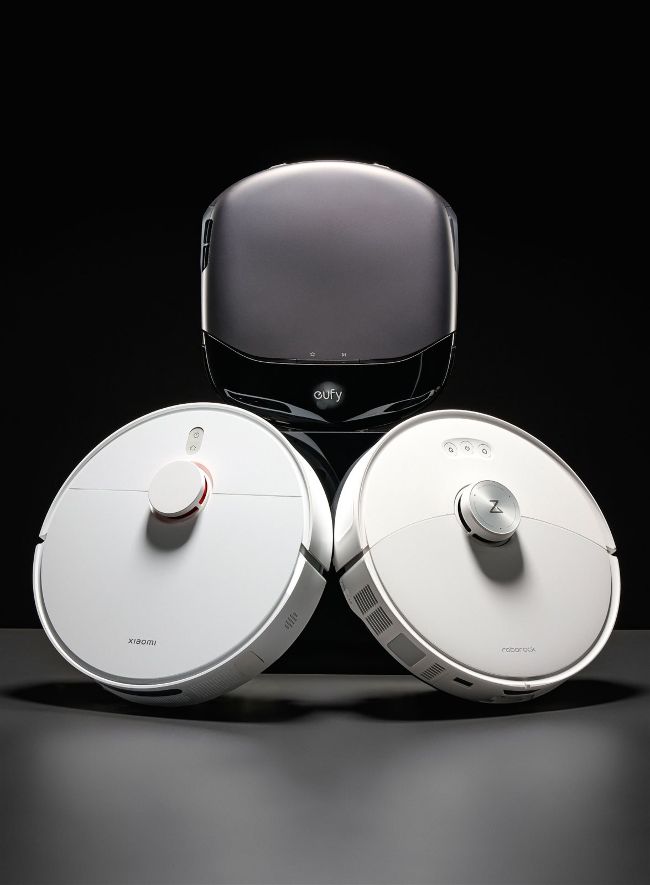
Photography: Neil Godwin
Let’s face it, if there’s a way to make our daily lives easier and less time-consuming and someone suddenly invents a machine that performs a particular household task for us, we’ll bite their arm off. Indeed, most of us have probably already got a dishwasher, washing machine and tumble dryer doing all the hard graft, so why not go the whole nine yards and include a machine that sweeps the floors, automatically, on its own, with almost zero human effort?
The historic timeline of robotic vacuum cleaners goes way back to 1997 when BBC’s Tomorrow’s World featured an early prototype of 2001’s Electrolux Trilobite, the world’s first commercially-available robot vacuum cleaner. This autonomous domestic bot was so futuristic it even boasted obstacle-avoiding ultrasonic sensors. Soon after, iRobot launched its first Roomba model and it was an even bigger hit, especially among tech-savvy early adopters.
Fast forward a couple of decades and today’s robot vacs are brimming with bundles of user-friendly tech and delivering better floor-cleaning results than ever before. Moreover, the recent dramatic increase in manufacturers jumping on the vac wagon – particularly from China – will not only help advance the already rock-solid technology powering today’s generation of robot vacs, but the sheer volume of different brands and models hitting the market will almost certainly bring dramatically lower prices.
WHAT IS A ROBOT VACUUM?
As if you didn’t already know, a robot vac is an autonomous device designed to clean floors with hardly any human intervention. Like any standard manual vacuum cleaner, all robot vacs are equipped with a brush roller – usually of the rubber variety which is better at beating dust out of carpet – and a vacuum mechanism that draws detritus through a short suction tube straight into a small bagless dustbin. Many models today also provide a mopping function though some are much better at it than others.
Robot vacs haven’t changed much in design since the very early days. While there have been D-shaped robots in the past – most notably the iRobot S9 and Dyson 360 VisNav – for some bizarre reason the vast majority of manufacturers have stuck to a circular shape which is odd given that 99.9% of homes have corners, and corners are where most dust and hair tends to lurk. To circumnavigate this issue, every robot vac today is also fitted with a revolving side brush that sweeps most matter hiding in corners towards the suction area. Given that even a side brush isn’t always successful, some manufacturers like Roborock now equip some of their higher-end models with a side sweeping brush that pops out an inch or two to reach corner debris more effectively.