Transparency, refraction and reflections
Painting glass and anything transparent doesn’t need to be as intimidating as it may first appear – Maddine Insalaco demonstrates her layered approach in oils
Maddine Insalaco
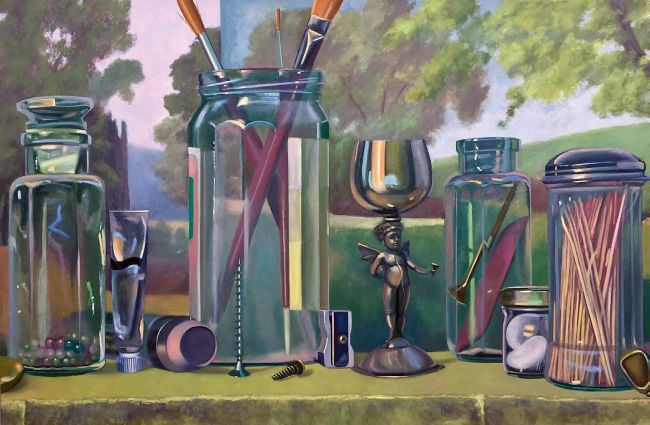
Harmony in Pink and Green, oil on canvas, 48× 72in (122× 183cm)
My technique for painting glass involves layers of wet on dry paint to make convincing forms emerge from a base of flat abstract shapes. I use a traditional mix of linseed oil and rectified turpentine which means the layers are slow to dry, so I typically set up a complex still life with multiple objects and light sources from which I can compose a number of paintings. This way I always have a dry surface to work on.
There are three characteristics of glass to consider when painting: transparency, refraction, and reflection. All these characteristics affect how we see glass, and each can be viewed in terms of a spatial expression.
Space and perception
I look carefully at my arrangement of objects and analyse the space they occupy. I extend this analysis to individual transparent objects, making it a point to distinguish the far side from the contents, then to the near side and to the location of the various reflections. Understanding this is fundamental because the layers of paint will be applied in this order, like a traditional landscape in oil.
When I understand what’s where, I observe what the still life looks like and how objects behind and inside any transparent container are affected by it – most obviously the shapes of objects within glass containers are distorted by refraction. The edges of anything seen through glass automatically appear as softer and a bit more obscure. Finally the colour of the glass, even if it appears clear, influences the colour we perceive the contents within to be. All these observations determine the sequence of paint application, edge manipulation and colour choices.