Reviews
Too much distance
Richard Whitehead finds an imbalance of routine match reportage in this study of the Trinidadian who became a Lord
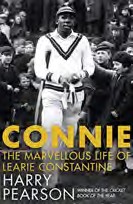
Connie: the Marvellous Life of Learie Constantine By Harry Pearson Little, Brown, HB, 356pp, £20
Learie Constantine’s status in the history of cricket in the Caribbean is incontestable. Alongside his team-mate George Headley and in later decades Frank Worrell and Clive Lloyd, his exploits helped to establish the primacy of the game in the region and forge the idea round the world of what the content and style of West Indies cricket entailed. That quartet inhabit a plateau somewhere above the scores of brilliant cricketers to emerge from the islands.
But Constantine was much more than just an extravagantly gifted, exuberant allrounder. In retirement he campaigned for racial equality in England, became a barrister and eventually the first black man to sit in the House of Lords. For the son of an overseer in a Trinidadian cocoa plantation, it was an extraordinary journey: a life that belongs as much in Hollywood as between hard covers.
Although he was at the forefront of West Indies’ first faltering steps in international cricket, he spent most summers as a professional with Nelson in the Lancashire League. From our perspective it is impossible to comprehend the impact of the arrival of a black man in a small provincial mill town in late-1920s Britain. Children peered in at the windows of his first lodgings; in the street he was asked whether his skin colour was the result of working in a mine, and there was hate mail among the letters of welcome he received.
That he became deeply loved and respected in the community – when he was ennobled he incorporated the name of the town into his title – was not just down to his prodigious sporting prowess but to his impressive humanity and the way in which he dealt with ignorance and prejudice.
Constantine is long overdue a proper biographical reappraisal and Harry Pearson, whose tour of the 21st-century northern leagues Slipless in Settle was Cricket Society/MCC Book of the Year in 2011, has taken on the task with the enthusiasm of someone who became beguiled by Constantine’s story as a boy.
Pearson is at pains to point out that his subject’s impact was more a matter of style than statistics. Constantine’s first-class average was an impressive 20.48 with the ball but only 24.05 with the bat, and he made just five first-class hundreds. He played in just 18 Tests, with what on the surface are modest results.
Yet John Arlott, Neville Cardus, Walter Hammond, CLR James and Plum Warner were among those who came under the spell of his scene-stealing charisma. He bowled at searing pace and sometimes celebrated a wicket with a leap over the splayed stumps; he hit boundaries that scorched across outfields or sailed into stands and fielded with an agility and athleticism that was at odds with much of what else was on display at the time. As Pearson notes, he would have been an extravagantly remunerated superstar in the IPL.
On and off the field there is rich material around which a biographer might construct a compelling narrative, yet Pearson’s efforts are only partially successful. Undoubtedly he would have been hampered by the distance between the second decade of the 21st century and the events he is trying to recreate. Constantine died as long ago as 1971 and team-mates, opponents and spectators are likewise long gone. But that does not entirely excuse the numbers of pages devoted to unnecessarily long and often tedious descriptions of matches. If the eternal question for biographers of the sport is to determine exactly how much cricket to include then he falls consistently on the wrong side of the divide.