Reviews
Your monthly critical round-up of performances, recordings and publications
THIS MONTH’S RECOMMENDED RECORDINGS Our pick of the new releases
Rachel Podger
plays the Bach Cello Suites on the violin PAGE 86
Afecing Elgar from the Brodsky Quartet PAGE 88
Gidon Kremer performs dazzling Weinberg PAGE 92
New York
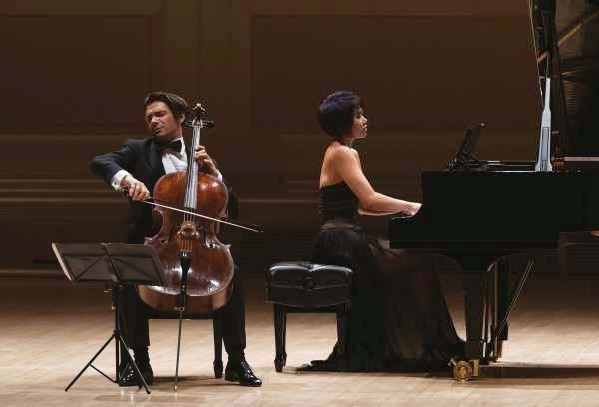
Intensity and ire from Gauier Capuçon and Yuja Wang
FADI KHEIR
REBECCA FISCHER (VIOLIN)
MILLER THEATRE, COLUMBIA UNIVERSITY 2 APRIL 2019
It is inspiring to watch former string quartet members strike out on their own after leaving the hallowed halls of a chamber music marriage: Becca Fischer of the Chiara Quartet did this with remarkable bravery inther performance of newly written works for solo violin at Millertheatre. She presented seven short pieces – all composed by women.
Returning Souls by Shih-Hui Chen was a short but lovely start to the programme, followed by Jessie Montgomery’s Rhapsody no.1, a delicate piece reminiscent of Ysaÿe, illed with beautiful, searching phrases of leaps and double stops and bits of melody. Although not perfectly executed, Fischer did the spirit of the work great justice. She gave a lovely introduction to Missy Mazzoli’s wonderful Dissolve, O Mytheart: ‘her use of space and time, especially the contrast of large spaces and very small spaces, is never exactly predictable but always just right.’the entirely muted opening section was perfectly timed on Fischer’s part, and whilether longer phrases were quite beautiful, the contrasting dance-like sections could have been a bit wilder, with larger and less careful gestures.
Time Is a Cage (Suzanne Farrin) was introduced as ‘an exercise in colour and timbre’. Fischer achieved some lovely efects with the extended techniques in this piece – luttery trill harmonics and very efective sul tasto playing.the most melodic work on the programme, Paola Prestini’s For Becca, had some nice phrases, but Fischer seemed a littlethesitant, and I felt it could have been played with more conidence. Lisa Bielawa’s One Atom of Faith was the most captivating work on the programme, with Fischer singing a text about a young woman struggling withther soul while accompanyingtherself on the violin. She gave a truly captivating performance of this very intimate musical and personal conversation.
ANTHONY HAWLEY
A wonderful piece closed the evening – the ‘Firelies’ movement from Gabriela Lena Frank’s Suite Mestiza. Fischer (above) captured the character of the piece, although there were a few too many missed notes, imperfect harmonics and moments of questionable intonation to make the performance truly great. Howeverther commitment to each work – along with the clarity of what she wanted to communicate andther strong personal connection to each piece – yielded a satisfying programme.
LEAH HOLLINGSWORTH
ARTEMIS QUARTET
92Y, KAUFMANN CONCERT HALL 9 APRIL 2019
The Artemis Quartet took a serious but beautiful approach to Barber’s famous Molto Adagio, and I especially loved the cellist’s elegance, satiny phrases and impressive bow control. Britten’s String Quartet no.2 followed, and the opening unison was illed with youthful curiosity and playfulness.the Quartet’s extremely articulate playing, clear characters and outstanding ensemble – especially in the energy of the bowing – brought the work to life.the cadenzas in the inal movement were all powerfully played, with good control and character – although I missed opportunities for vulnerability or tenderness in the piece.
Schubert’s sensational String Quartet no.14 in D minor ‘Death and the Maiden’ followed the interval, and the Allegro showed of the brilliant spiccato of the ensemble (especially from the irst violin), as well as nuanced time-taking.the second theme in the cello was beautifully understated and quite elegant. I loved the breathy bell-tones in the opening of the Andante and the pristine intonation and thoughtful use of vibrato led to many tender moments in the movement.the cello variation was particularly powerful – intimate and playful all at once, and quite special.the quartet inished with great energy although the inal Presto seemed to run away a bit, teetering just on the edge tempo-wise.
A Bach chorale closed the evening and the quartet’s purity of sound was a ittingly simple ending to the programme.
LEAH HOLLINGSWORTH
GAUTIER CAPUÇON (CELLO) YUJA WANG (PIANO)
CARNEGIE HALL 10 APRIL 2019
It might have been diicult to tell which members of this eager audience came for Gautier Capuçon’s elegant intensity, or for Yuja Wang’s iery pianism.the reality is that the two of them combined (as part of Wang’s Perspectives series for Carnegie Hall) were more than the sum of the parts, which is always happy news.
The opening of Franck’s Violin Sonata in A major (in Jules Delsart’s transcription) had languid repose. Capuçon’s restraint was matched by his spot-on intonation – even high on the strings. In the inal movement, both artists were swept away by the chase, with many listeners likely humming the unforgettable theme at the interval.
Rachmaninof’s Cello Sonata op.19 made a study in contrasts. In the second movement, Capuçon gave a mini masterclass in spiccato bursts, demonstrating ideal bow pressure and attack. But in the Andantethe let the long arches unfold with commensurate bow strokes – so luxurious that one could imagine cupping the closing bars in both hands.
In between, Chopin’s Introduction and Polonaise brillante op.3 was delightful, with the cellist showing a clean, economical technique, especially in the lurry of harmonics near the end. And though the honours were fairly evenly divided during the night, the formidable piano role gave Wang a bit more of the spotlight.
As the irst encore, ‘he Swan’ from Saint-Saëns’s
Carnival of the Animals avoided cliché in favour of delicacy and stirring presence. And for the last word, the duo dispatched Piazzolla’s Le Grand Tango with sizzling abandon.
BRUCE HODGES
JAMES EHNES (VIOLIN)
LONDON PHILHARMONIC ORCHESTRA/
EDWARD GARDNER
DAVID GEFFEN HALL 15 APRIL 2019
The introspective air of the Sibelius Violin Concerto is a good match for the reined restraint of James Ehnes. Appearing with Edward Gardner and the London Philharmonic Orchestra as part of Great Performers at Lincoln Center, the violinist was beguiling, especially in the sumptuous central slow movement.
To browse through more than a decade of The Strad ’s recording reviews, visit www.thestrad.com/reviews
Ehnes doesn’t yell, nor doesthe need to. To paraphrase, ‘speak softly and carry a big technique.’ His tendency to whisper (eloquently) meant that Gardner and the ensemble occasionally overpowered his utterances, but nevertheless, the violinist displayed masterful control. Whenthe needed to growl,the did, such as in the rugged inale. Whether in octaves or double-stops, his intonation was pleasingly secure, and the sheer tone from his instrument – the 1715 ‘Marsick’ Stradivari – was often rapturous.
The evening began with a forceful Egmont Overture, with Gardner and the LPO musicians taking nothing for granted – perhaps a preview of Beethoven’s 250th birthday next year – and the orchestra’s strings front and centre. And after the interval the ensemble added even more strings for its plunge into Mahler’s First Symphony – tasteful but with gusto – emphasising the composer’s daring and innovation.the cellos and double basses were particularly on ire, especially the orchestra’s principal bassist in the lonely solo that opens the third movement.
BRUCE HODGES
London
TABEA ZIMMERMANN (VIOLA) ADAM WALKER (FLUTE) AGNÈS CLÉMENT (HARP)
WIGMORE HALL 15 APRIL 2019
These three players met for the irst time to give this afternoon concert, but the rapport between them belied the fact.the best-known work on the programme was Debussy’s Sonata for lute, viola and harp, which came in the middle.they opened with Arnold Bax’s Elegiac Trio, written in 1916 whenthe probably came up with the same combination independently. It certainly its his love of Ireland;the wrote the trio in response to the 1916 Easter Rising.the playing had a bewitching sensibility, both relaxed and intense, with lute and viola in easy dialogue and Zimmermann responding beautifully to Bax’s instruction ‘singing’.