ORCHESTRAL PLAYING
HIDDEN IN PLAIN SIGHT
Gerald Elias has spent many years as a professional orchestral violinist – in the Boston SO and Utah Symphony – and has been music director of Salt Lake City’s Vivaldi by Candlelight chamber orchestra since 2004. Here he explores some of the universal challenges faced by orchestral string players which go unrecognised by audiences
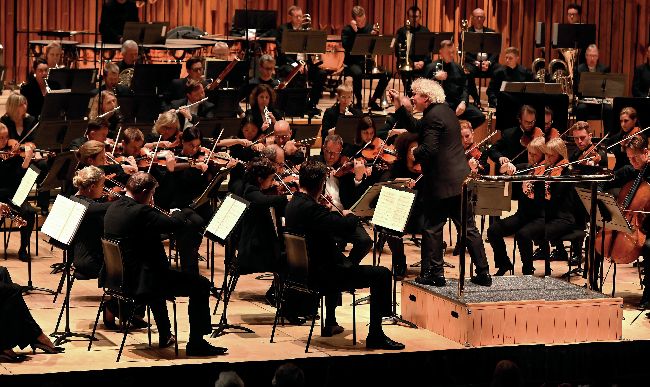
Two possible ways to arrange orchestral string sections: Simon Rattle conducts the London Symphony Orchestra in the standard seating arrangement of second violins to the left of the firsts;
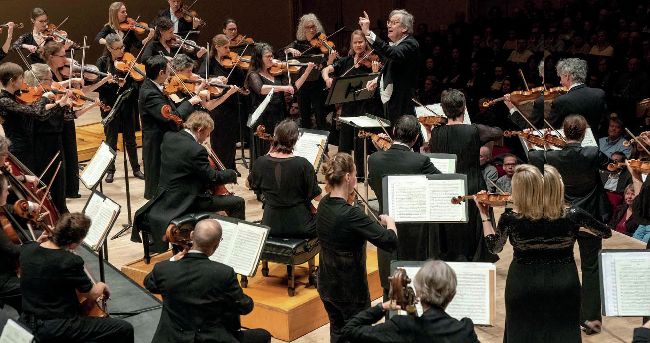
while John Eliot Gardiner directs the Orchestre Révolutionnaire et Romantique in the Baroque seating arrangement of second violins to the conductor’s right
UNMUSICAL CHAIRS
If you’ve lived in your house for 20 years, imagine your disorientation if one day you arrive home to find all the furniture in the wrong places. Your bed’s in the kitchen. Your couch is in the garage. Holy feng shui!
Maybe that’s an exaggeration, but it’s not unlike what orchestral string players experience when a guest conductor reconfigures the onstage seating.
Although there are some valid historic and acoustic reasons for occasionally rearranging the deckchairs, it’s fairly standard today for second violins to sit to the left of the firsts, with violas, cellos and basses on the other side of the stage. When I conduct my Baroque orchestra for Vivaldi by Candlelight in Salt Lake City, for example, the first violins are to my left – they’re the lucky ones; no one ever bothers their seating – and the seconds are to my right, so they can be equally seen and heard, because so much Baroque music features the interplay between violins. My violas are to the left of the first violins, enabling their instruments to face outwards – thus helping to unveil their beguiling inner musical line. The harpsichord is placed centrally, facing me. Cellos and basses are to the right of the second violins, which crucially places the basso contingent next to the harpsichordist’s left hand, which is the part they essentially double. But I can’t overemphasise that what makes this whole arrangement work smoothly is that the musicians are used to it: we’ve done it the same way for 15 years.
As an orchestral violinist, I’ve endured some certifiably bizarre seating arrangements. The Utah Symphony once had a guest maestro conducting Mendelssohn’s magnificent oratorio Elijah, and he positioned the full chorus at the front of the stage, standing, and the orchestra behind it, sitting! The conductor insisted that that was how Mendelssohn did it, but you can imagine the visibility and ensemble problems. A periscope would have helped, but as it wasn’t invented until 1854, eight years after Elijah was composed and premiered, that solution would have been troublingly anachronistic. What guest conductors sometimes fail to consider is that, week after week, professional orchestras often have a maximum of four rehearsals to prepare entire programmes, and striving for perfection is challenging enough even under the best conditions.