Reviews
RECORDINGS
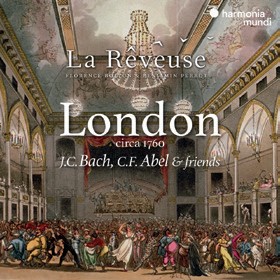
LONDON, CIRCA 1760
OLIVIER SCHICKE
ABEL Concerto a Viola da Gamba Concertata; Quartet in G; 27 Pieces for Bass Viol: nos.24 and 26
BACH Quartet op.8 no.2
ERSKINE Trio Sonata no.6
FORD Instructions for Playing on the Musical Glasses
GEMINIANI Pieces for English guitar
STRAUBE Largo
La Rêveuse/Florence Bolton (viola da gamba)
HARMONIA MUNDI HMM905380
Baroque salon music at its most alluring
This low-impact, high-finish album invites us to relax in a late-Baroque London salon for an evening’s gentle entertainment. The cosmopolitan nature of the names involved underlines what an artistic honeypot the English capital was at the time, to a degree only recovered two centuries later.
The tenor of the album is set by Florence Bolton’s soft-grained gamba in a modern reconstruction of a concerto by Abel, the celebrity gambist of 1760s London. Modern recording allows such pieces to shine in a way almost impossible in our larger concert halls, and the recorded balance doesn’t put pressure on Bolton to equate virtuosity with volume; her colleagues weave around her as courtiers to a queen. More ephemerally charming still are the two movements of a G major Quartet, in which flute and violin assert musical parity with Abel’s gamba.
At around 90 seconds each, two little pieces for ‘English guitar’ by Geminiani reveal more expressive variety than Abel’s pieces in their entirety – but then two excerpts from set of 27 serve to illustrate what an artist Abel himself must have been, captivating his audiences with long-breathed soliloquies worthy of his Shakespearean contemporary David Garrick. The curtain closes on a note of distant enchantment, with a pair of 1761 pieces by Ann Ford for glass harmonica, flute and guitar – the last of several delightful discoveries.
PETER QUANTRILL
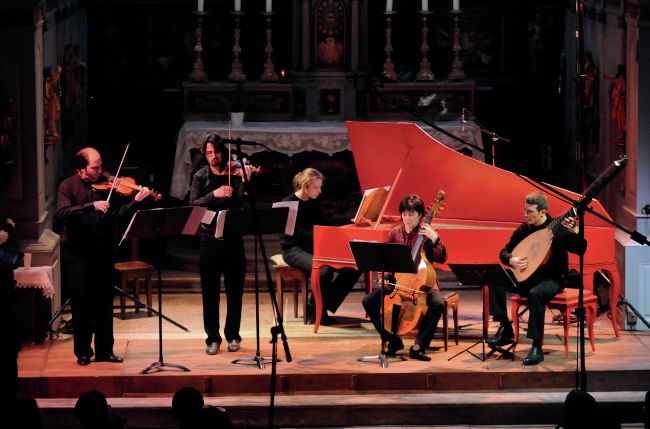
An evening of delightful Baroquerie from La Rêveuse
BACH
The Cello Suites on Six Different Instruments Ronan Kernoa (cello)
RAMÉE RAM2404 (2CDS)
An original take on these much-recorded suites pays dividends
Ronan Kernoa earns his place in a crowded catalogue by interpreting the term ‘violoncello’ flexibly and performing each suite on a different type of instrument. His use of treble viol (no.1) and six-string bass viol (no.4) requires transposed versions of Bach’s text (a perfect eleventh higher for no.1). He tinkers with pitch issues, too, tuning no.6’s five-string violoncello piccolo a tone higher than his adopted standard (c.400Hz) for the other instruments. Kernoa’s introduction of lute-like pizzicato in the repeated sections of no.4’s Sarabande and Bourrées is another distinctive feature – not one for the purist, but effective nonetheless! The wide range of instrumental timbres captured in this close, warmly resonant recording ensures that his accounts differ markedly from their competition.
Kernoa is an accomplished executant on all six instruments, his interpretations suggesting much careful preparation and experimentation with period bows. His tempos are largely cautious (sample the gigues of nos.4 and 6) but pliant, judicious rubato usage winningly reflecting the rhetorical diversity of the preludes. He negotiates multiple stopping adeptly and with due care for voicing, as in no.6’s sarabande and the fugal section of no.5’s Prelude. His light, articulated bowing gives agility to most of the courantes and gigues and many of the galanteries, particularly the gavottes of no.5. Allemandes are consistently well shaped and sarabandes are mostly profound and reflective, though no.1’s loses some of its nobility in this revised instrumentation/transposition and no.2’s seems ponderously realised. Extempore ornamentation is introduced, if somewhat unusually and sparingly, and occasional links into repeated sections are mostly persuasive.
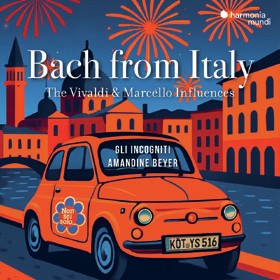
BACH FROM ITALY: THE VIVALDI & MARCELLO INFLUENCES
ROBIN STOWELL
BACH Brandenburg Concertos: no.3 BWV1048, no.4 BWV1049, no.5 BWV1050; Concertos: D minor for two violins BWV1043, D major for three violins BWV1064R, A major for oboe d’amore BWV1055R, C minor for oboe and violin BWV1060R
A. MARCELLO Oboe Concerto in D minor
B. MARCELLO Violin Concerto in E minor
VIVALDI Concertos: D minor for two violins and cello RV565, B minor for four violins and cello RV580
Gli Incogniti/Amandine Beyer (violin)
HARMONIA MUNDI HMM902769/70 (2CDS)