MAKING MATTERS
Seeing is believing
Points of interest to violin and bow makers
Luiz Amorim demonstrates how infrared reflectography can be used in violin restoration, as a non-invasive method for diagnosing problems
Lutherie
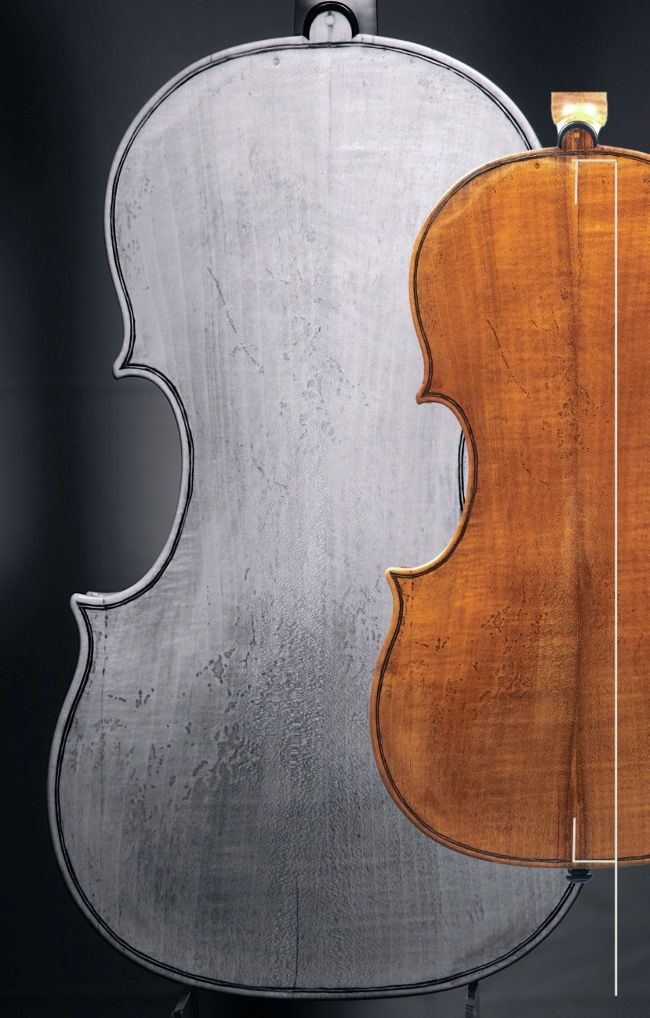
Accumulation of minerals in the wood grain is not reflected in the IR light FIGURE 1 Back plate of the Testore violin. In natural light, darker lines along the centre joint appear concerning; however, the infrared image behind confirms they are non-reflective mineral streaks within the wood grain – not cracks or repairs.
In the study of fine violins, every detail matters – especially the ones hidden from the naked eye. While traditional lutherie relies on touch, intuition and trained visual assessment, modern technology increasingly offers tools that reveal what lies beneath the varnish. Among them, infrared reflectography (IRR) is emerging as part of a quiet revolution in condition diagnostics.
Long known for its use in analysis of paintings, IRR has more recently found its place among the diagnostic techniques used by violin experts. By capturing the way near-infrared (IR) light reflects off a surface and penetrates through layers of varnish, dust and retouching, it offers a non-invasive glimpse beneath the surface. IRR is now used alongside other technologies such as dendrochronology, ultraviolet fluorescence, X-ray imaging and comparative analysis. What IRR reveals can influence both restoration decisions and the real condition of historical instruments.