LOWERING YOUR BAR
STORY & PHOTOS BY CHRIS COLLARD
Tire pressure… Does one size fit all?
Sometime in the early 1980s, I was on one of my first four-wheel-drive trips with my new Toyota Hilux. Stopping at the trailhead, everyone started letting air out of their tires. Clueless as to why I asked one of the guys, “Whatcha doing?” With his two-word reply, “Airing down,” I asked the next dumb question… “Why?” His brief explanation, which included something about traction, began a multi-decade edification on the merits of reduced air pressure. What I’ve learned is that in the same way the Inuit use many words to describe snow, there are numerous variables when it comes to airing down. In this Backcountry Skills, we’re diving into the why, when, and how much when it comes to lowering the bar.
TIP: THE APPROPRIATE TIRE PRESSURE WILL VARY DEPENDING ON RIM DIAM- ETER, TIRE ASPECT RATIO, VEHICLE WEIGHT, AND TYPE OF TERRAIN.
Today, when someone asks me how much they should air down I usually respond, “I have no idea,” and initiate a discussion on the variables that might affect my answer. Things to consider are wheel diameter and tire aspect ratio, type of tire and load rating, weight of vehicle, do they have standard wheels or beadlocks, their driving style, and type of terrain. The latter (insert mud, snow, sand, granite, etc.) can be broken down into an infinite number of subcategories, each with an ideal pressure based on any combination of the former.
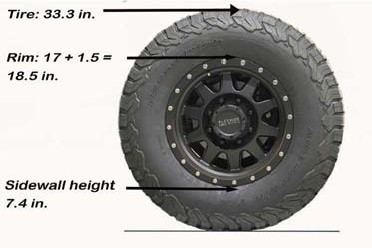
Rim diameter and tire aspect ratio significantly affect side wall height and the ability to effectively reduce air pressure. Note the 35x12.5R15 (center) and 295/70R17 (33.3-inch, right) tires provide more sidewall than the 37x12.5R22 (left). The same 37- inch tire on a 17-inch rim will provide an additional 2.5 inches of sidewall, greatly improving its function in soft sand, snow, or rock crawling.

Crossing soft, muddy rice paddies in Cambodia necessitated dropping air pressure on the Land Rover Defender to about 15 psi.
Wheel Diameter, Sidewall, and Load Rating