PARADISE ON FOUR WHEELS
Ten days exploring magical K’gari
STORY & PHOTOS BY DAN GREC
At the top of the bucket list for every four-wheel driver, Fraser Island off Australia’s East Coast easily boasts the best beach driving in Australia. For decades many have referred to the island as paradise, and now that it has been re-named back to the Aboriginal name ‘K’gari’, it should be no surprise the name translates to ‘paradise’.
K’gari is the world’s largest island made entirely from sand—27 cubic miles of the stuff. Much more than just sand, however, K’gari also boasts huge inland rainforests, unique wildlife, old-growth forests up to 1,000 years old, and more than 865 species of plants. This incredible island paradise was added to the UNESCO World Heritage List in 1992, and most importantly for us, the entire island can be explored in your own four-wheel drive.
Always on the lookout to include family, Katie and I meet up with my Uncle Ron, and together we load up on all the supplies we can carry in Hervey Bay, a few hours North of Brisbane. We have planned ten days on the island, including a criss-cross route from south to north with the aim of visiting all the highlights and out-of-the-way corners the island has to offer.
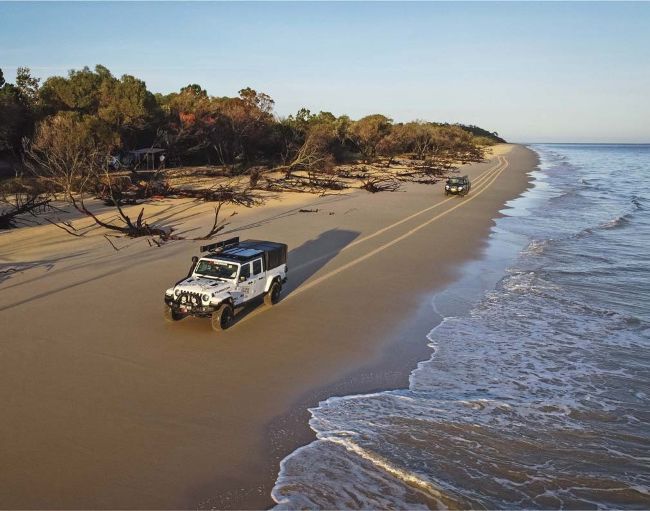
Low tide allows just enough beach for an exit.
Ferry to paradise
K’gari sits barely half a mile off the mainland, and multiple barges and ferries make the crossing continuously, transporting an armada of well-equipped 4x4s and madly grinning people. Many of the decked-out vehicles could easily be on the cover of a magazine, and they’re all packed to the brim, ready for adventure.
The excitement is palpable as we join the lineup of vehicles before reversing onto the ferry. Loading the ferry in reverse means we’re lined up to drive straight out on arrival, which makes life much easier. The crossing takes barely twenty minutes, and we’re quickly off the ferry and onto the island. Driving on an island entirely made of sand means we need to air down our tires to 16psi all around. At this pressure, the contact patch has increased enormously and will provide plenty of grip in the soft sand. It’s reassuring to know I can still go a lot lower if the need arises, but for now, I’ll walk the line between traction, fuel consumption, and speed.
While crossing the island, I’m impressed to see enormous eucalyptus trees forming a dense jungle. Very little light penetrates the forest floor. Tracks are rutted and crisscrossed with tree roots. Washouts and rubber matting are designed to prevent further erosion.
Ninety minutes later we arrive on the far eastern side of the island during a rising tide, almost the worst possible time to start our first beach drive. We need to travel a few miles south to our first of many beach campsites, and we’re all on edge as we race the incoming tide. Thankfully, we make it through with only one small splash of salt water. We’re elated to see we have our pick of the sites tucked in behind the dunes; there’s not a soul in sight.