AFTER THE GOLDRUSH
Twelve years on from FLEET FOXES’ debut, Robin Pecknold has beaten anxiety to reach new creative heights with their latest album, Shore. He talks surfing accidents, cork forests and fallen heroes - and what’s changed since his band’s extraordinary breakthrough. “I feel much less self-conscious than I used to,” he tells Michael Bonner.
AS a child, growing up in his native Seattle, Robin Pecknold suffered from debilitating allergies. “By the time I was 14, I couldn’t go outside for three years,” he says. “There were spring and summer allergies. I could still go out in winter and fall, but it’s like I couldn’t even have a window open the rest of the time. So I spent a lot of time indoors and read fantasy books, like The Lord Of The Rings.”
Gazing through the windows on the world in its fertile, vibrant glory, he began creating his own mental analogue for it, fed by his own imagination. “It’s the idea of something unreachable, and you amplify it,” he agrees. “So I was writing stories, and songs, just making up worlds.”
In 2020, Robin Pecknold found himself forcibly housebound once again. While locked down in his Greenwich Village apartment, he “watched what was going on, just being anxious, worried and confused. I ended up having three months to reflect and notice the world changing and be horrified - and then encouraged by so much social awareness and class consciousness.”
But Pecknold had other pressing business to attend to. Since September 2018, he’d been working on a new Fleet Foxes studio album, but now he was stuck. Initially, he had envisaged a typically ambitious project - nothing less than a celebration of life in the face of death - but progress had become blocked by lockdown and Pecknold’s own artistic tussles.
“I had a half-finished record that had no lyrics and no vocals and a lot of instruments recorded,” he says. “It was beginning to feel like an albatross. I didn’t want to finish it this year, then wait until next year to put it out. But I don’t want to abandon it.”
In June, as New Yorkers took their first cautious steps back to normality, he found release. “I just couldn’t take it any more and started going on 12-hour drives,” he says. Setting off from Greenwich Village, he drove his Toyota 4Runner in six-hour loops, heading through Upstate New York: up to Lake Minnewaksa, over the Shawangunk Ridge and into the Catskills. Lacking “any kind of lyrical perspective” prior to the beginning of lockdown in March, these journeys not only reconnected him with the outside world - they enabled Pecknold to write. He found himself creatively unshackled.
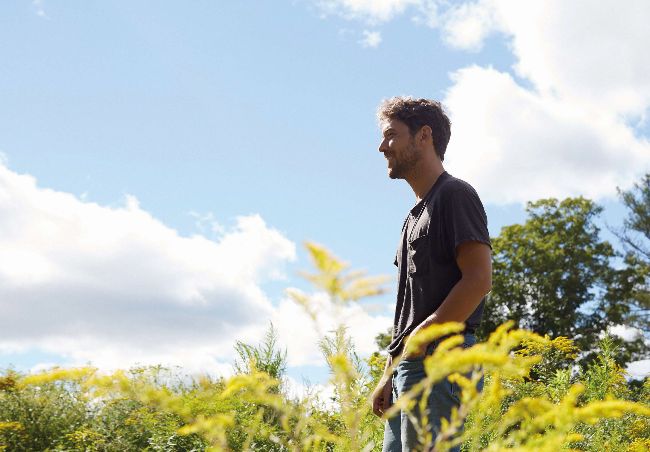
Sun-blinded: Robin Pecknold emerges from lockdown with a new Fleet Foxes album performed almost entirely by himself, August 2020
Photo by EMILY JOHNSTON
“The lyrics I had been searching for all year began to come to me,” he says. “I’d pull off to the side of the road and jot stuff down. It felt like going to the beach with a metal detector. Finally, I’m going to find something.”
As it transpires, the arrival of Shore - the Fleet Foxes’ fourth album - couldn’t have been better timed. Completed as the pandemic’s first wave receded, Shore is yet another musically adventurous album from Pecknold, full of warmth, grace and lightness; the perfect respite for these uncertain times.
“It’s incredibly meditative, a constant source of joy,” agrees Pecknold’s friend, Kevin Morby, who guests on Shore. “People need to be engaged and active with the world’s problems right now, but just as necessary is people need to have something to turn to that reminds them that the world can be beautiful. This record will provide that relief for a lot of people, and that’s incredibly important right now.”
But even without the hiatus caused by Coronavirus, Shore had a long, knotty genesis. Its creation includes a neck injury, a surfing accident, Portuguese cork forests, Frank Sinatra’s touring drum kit, Mahayana temple blocks and “nature therapy”. Although Shore is overshadowed by the deaths of fellow musicians Richard Swift and David Berman, there is also a family drama closer to home. It is also performed almost entirely by Pecknold, his Fleet Foxes bandmates absent as a consequence of the pandemic. That the record got completed at all, Pecknold credits partly to the passing of an anxiety that had dogged him for a number of years.