TAKIN’ OFF!
From child prodigy to jazz colossus, HERBIE HANCOCK has repeatedly revolutionised music. In a rare audience with the rockit man, he tells Graeme Thomson about his remarkable career, alongside giants including Miles Davis and Joni Mitchell, and as a formidable solo artist in his own right. But what keeps this tireless innovator going into his ninth decade? “I like to be ahead of the curve,” he says. “I’m trying to make a curve!”
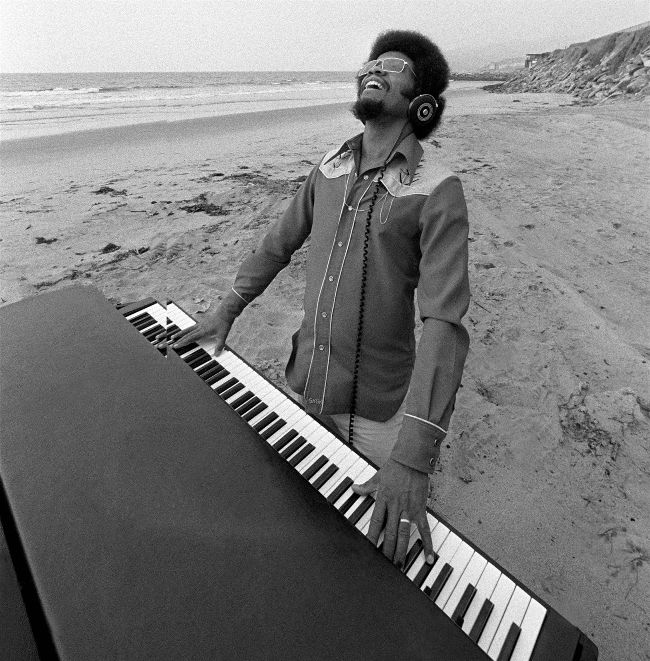
Shore feels good: Herbie Hancock, October 21, 1976
Photo byJIM McCRARY
HERBIE Hancock is staring intently at the plug socket on the wall. “Ever since I was a kid, I would look at something like this and I would start playing with it because I wanted to know what it did,” he says. “Then I’d start thinking, ‘I wonder what would happen if I put this with that? Would
JIMMcCRARY/REDFERNS that work? Of course, I’d get electrocuted…” He laughs. “It’s because I’m curious. That’s part of my basic nature. I’ve been so ever since I can remember.”
“I’M CURIOUS… I’VE BEEN SO EVER SINCE I CAN REMEMBER”
Which is as useful an explanation as any for Hancock’s mercurial musical career. Today, the legendary pianist is in a hotel room in Edinburgh. Not long arrived on a flight from Denmark, he has a much-needed rest day before performing again with his superlative three-piece band at the city’s prestigious International Festival the following night. Looking many years younger than his allotted 82, Hancock is a courtly presence: alert, quick to laugh and happy to roam across one of the most storied and eclectic careers in music, which has taken him from bebop and blues to Afrofuturism, funk, fusion, electronic experimentation, ambient, pop and hip-hop.
Chicago born, classically trained, Hancock was discovered in 1960, aged 20, by trumpeter Donald Byrd. He made his recording debut for Blue Note at 22 with Takin’ Off!, a hard bop gem which opened with “Watermelon Man”, the first of many standards Hancock has composed. He became a member of Miles Davis’s legendary Second Great Quintet the following year and between 1963 and 1971 played on a series of Davis’s groundbreaking records, from Seven Steps To Heaven to On The Corner. During the same period, he continued to record pioneering albums for Blue Note, among them Empyrean Isles, Maiden Voyage and Speak Like A Child.
In the early ’70s, having left Miles’ band, Hancock became fascinated by electronic music. The adventurous, avant-garde Afrocentrism of his Mwandishi sextet led to the more directly funky approach of his Headhunters band. Their 1973 debut, Head Hunters, heavily influenced by Sly Stone and James Brown, became a commercial crossover hit and remains a pinnacle of jazz-funk fusion. Several more vital records in a similar style followed. His current live show draws heavily from this period, but Hancock has never been content to rest on old glories. “I do play some of my old songs, but they have evolved,” he says. “I don’t like to keep playing the same thing year after year.” He became a pop star in the ’80s with his funk-rap crossover “Rockit” and remains a tireless innovator into his ninth decade.