GIVE UP Google
Google is ruining its tools with unwarranted data collection and unwanted AI. Robert Irvine explains how to de-Google your life by switching to private alternatives
Google is now so integrated with our lives that it’s difficult to imagine being without it. We ‘google’ for information online, access the web using its Chrome browser, send emails via Gmail, get directions from Google Maps, and much more. Those tools are popular for good reasons: they’re free, easy to use and bother to look for alternatives. In the past few years, Google has ‘enhanced’ many of those tools with AI features. Some additions are undoubtedly useful – such as Google Translate’s new ‘Live translate’ option (see page 42) – but others are less welcome and further compromise our privacy.
WHAT YOU CAN DO
• Search the web without being targeted with adverts
• Ditch Chrome for a faster, more private browser
• Switch from Gmail to an encrypted email service cater perfectly to our daily needs. However, they also come at the cost of letting Google collect and monetise our personal data for advertising purposes.
That’s hardly a revelation: Google settles several lawsuits every year for collecting users’ data without their permission. But we all continue to use its tools regardless, mainly because we never
• Avoid Google Maps clutter with a simpler alternative
• Upload your files to a more secure storage service than Google Drive
• Back up your photos without them being analysed by Google
Here, we recommend the best replacements for Google tools, so you can try de-Googling your life. They won’t collect your personal data, target you with ads or force unwanted AI on you – and they’re free to use (though some also have paid-for plans).
We haven’t included YouTube or Android, which could fill one of these features on their own. Nor have we suggested Microsoft alternatives, which also pose privacy and AI concerns.
STOP USING GOOGLE SEARCH
Google built its business empire on its fast, reliable and comprehensive search engine. This now has a 90-per-cent share of the search market and handles over 10 billion searches per day. But if Google Search launched today in its current form, we doubt it would achieve anywhere near the same level of success.
Gone are the cleanly presented results that focused on finding the most relevant pages for your search queries. Now you have to wade through sponsored results and products, ‘People also ask/search for’ questions, videos and AI Overviews.
The latter are a particular nuisance because they’re often inaccurate, can’t be removed and push genuine results further down the page. AI Overviews also deprive websites of the ad revenue they need to survive, because people are reading the AI summaries without visiting the sources of that information.
Previously, most sites used Google’s Ads system to make money that paid their staff, funded their content and supported their upkeep. But now Google has diverted that revenue to itself, while still cannibalising those websites for answers to users’ questions.
There are tools that clean up Google search results, such as the brilliant Chrome extension ‘Bye Bye, Google AI’ (www.snipca.com/58573). This hides all the aforementioned annoyances and the new AI Mode tab (see screenshot below). But they don’t fix other problems with Google Search, such as how it collects your data to personalise results and target you with ads.
What’s more, the quality of Google results has noticeably declined, with more AI-written content; prioritisation of the same big sources; and ranking rubbish sites that use SEO tricks above useful ones that don’t. For all these reasons, you should give up Google Search for a better, more private alternative.
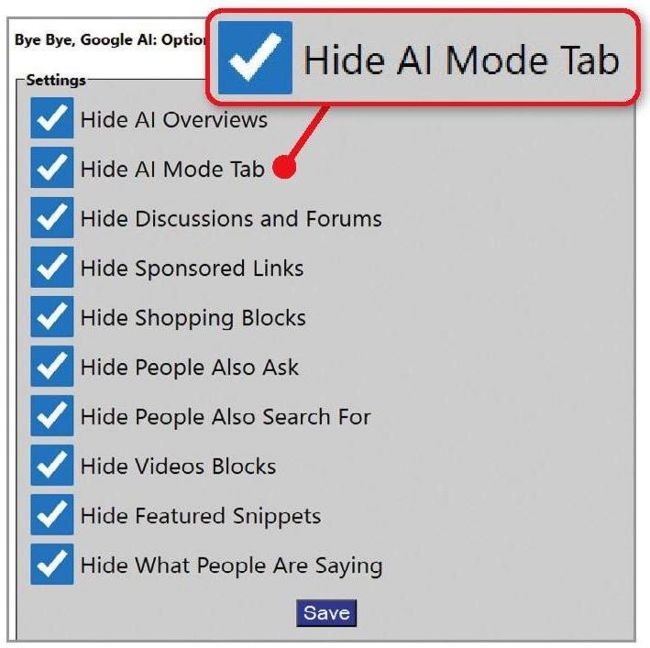
‘Bye Bye, Google AI’ removes the clutter from Google search results
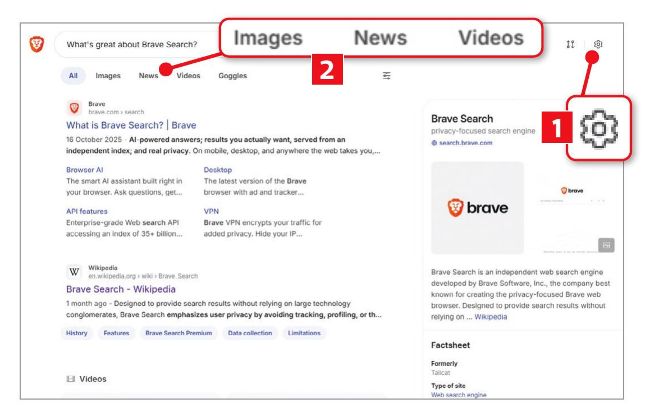
Brave Search uses its own search index, doesn’t collect your data and lets you hide its AI summaries – unlike Google
What to search with instead
The obvious alternative to Google Search is DuckDuckGo (www.duckduckgo.com), which doesn’t collect your search data and use it to target you with ads. But that privacy-focused search engine has been popular for 15 years now, so you’ve probably already decided whether you like it or not.
A newer option is Brave Search (www. snipca.com/58578), which launched in 2022 and now has around 100 million users. Unlike DuckDuckGo, whose search results are powered by Microsoft’s Bing (as well as its own web crawler), Brave Search mainly uses its own independent index, which it built from scratch.