LEARNING TO FLY
Sixty years ago, David Crosby, Gene Clark and Roger McGuinn bonded over a love of folk music and The Beatles. With Michael Clarke and Chris Hillman, they became THE BYRDS. What followed - jealousy, schism and divergent paths to equally wondrous music - has never erased the chiming folk-rock sound of the original band. "The five of us had a magic," discovers GRAYSON HAVER CURRIN.
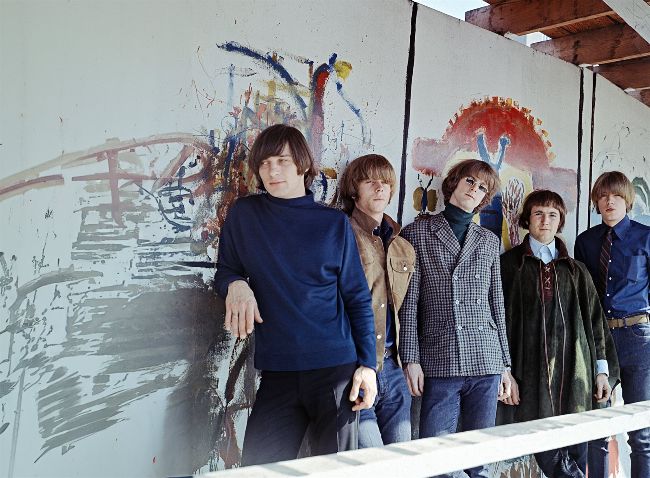
Changing the times: The Byrds in November 1965 (from left) Gene Clark, Chris Hillman, Roger McGuinn, David Crosby, Michael Clarke.
Photograph: GUY WEBSTER
Guy Webster
DAVID CROSBY TAUGHT ROGER MCGUINN HOW to drive.
It was July 1960 in Los Angeles, and Crosby, the son of a cinematographer, was playing a lead in Samuel Beckett’s play Endgame at the Ash Grove. He would emerge from a trash can, spout some lines, and descend again. McGuinn was a teenager on tour with The Limeliters, a grinning group of commercial folkies in town to cut a live album, also at the Ash Grove. A son of Chicago who’d matriculated to the then-new Old Town School of Folk Music before he was 15, he loved Leadbelly and Josh White, Earl Scruggs and Pete Seeger. Crosby was relatively new to music, having played just a few shows in coffee houses, so McGuinn showed him some chords. McGuinn – Jim in those days – was relatively new to the city, so Crosby showed him around.
“You didn’t need to drive in Chicago. You could walk everywhere,” McGuinn tells MOJO, laughing as he recalls getting behind the wheel of Crosby’s convertible. “He had a stick shift, and I went up this steep hill, worrying about braking and clutching. At least he had a good sense of humour about it.”
McGuinn’s Limeliters session was done, so they continued north to Santa Barbara, where Crosby had grown up. His mom made the kids lamband-avocado sandwiches, the first time McGuinn had ever seen this strange fruit. He spent the night, then took the bus into San Francisco. “I thought,” remembers McGuinn, “I want to be friends with him.”
Only four years later, the world was radically different. By the summer of 1964, John F Kennedy had been assassinated. The Cold War was simmering on multiple fronts. And months earlier, The Beatles had shaken the nation from trauma on The Ed Sullivan Show. McGuinn and Crosby had both been to New York, passing baskets on the city’s peculiar folk scene, and were both back in Los Angeles, Crosby giving it another go with folk fare. Obsessed with gadgetry and technology since he was a child, McGuinn, however, had started to discover something new. Sat in The Folk Den, the front room of Hollywood musical locus the Troubadour, Gene Clark, another folkie in exile, saw it happen.
“He was sitting in a corner strumming his 12-string guitar and singing a Beatles song. I thought, Man, this guy’s got the right idea,” Clark remembered. “We decided we’d become… a duet, doing the English style. So we started writing songs immediately.”
That’s where Crosby found the pair, playing Clark numbers that, he later recalled, “just pulled me like a magnet.” He added a high harmony. He wanted in on this new sound, grounded in folk but shimmering like The Beatles.
McGuinn had doubts. “It was beautiful, but I wasn’t quite sure I wanted to work with David,” he says. “He had an addictive personality and a slight drug dependency. He said, ‘I want to be in your band,’ but we didn’t really have a band. We were just writing songs.”
Crosby put his cards – or, rather, his connections – on the table. He had worked with Jim Dickson, a proven producer at LA jazz label World Pacific who had been given a key to record upstarts, off the books, at the label’s studio near Beverly Hills. Crosby vowed he could get this ad hoc trio some time. “I’m like, You’re in,” says McGuinn.
Less than a year later, the world had changed again, because of the band that began to take shape that night. Adding drummer Michael Clarke and bassist Chris Hillman, they cut a version of Mr. Tambourine Man that pioneered the folk-rock idiom, and on two albums – Mr. Tambourine Man and Turn! Turn!
Turn!, released during a six-month span in 1965 – reignited rock’s imagination and reshaped its future.
“They’re cutting across barriers which most people who sing aren’t even hip to. They know it all,” said Dylan that year. “If they keep their minds open, they’ll come up with something fantastic.”
THE KID THOUGHT THAT THE BEATLES WERE downstairs.
A few months after the five Byrds began playing together, when they still called themselves the Jet Set, Jim Dickson arranged a meeting with Ben Shapiro, an area impresario who ran the jazz hotspot Club Renaissance. Dickson hoped Shapiro could get the band some gigs, so they schlepped their instruments to his house one afternoon. After several songs, his daughter rushed downstairs to meet The Beatles, only to find five unknown longhairs. The next day, though, Shapiro told the story to his client, Miles Davis. “Kids have a way of knowing these things,” Davis nodded.