FRENCH ÉLAN
Jim Graham throws caution to the wind, dons the most stylishly voluminous trousers he can find, and charges headlong into this article on élan through the ages.
ÉLAN
NOUN: a combination of style and vigour.
Word origin C19: from French, from élancer -to throw forth.
There is a tendency to ascribe characteristic stereotypes to various nations - the Germans are methodical and organised, the Italians are melodramatic and excitable, the French have flair and a certain je ne sais quoi. These are convenient and lazy generalisations that are oft abused and overused in many forms of media, and indeed in history and wargaming.
Many generalisations will have a historical nucleus, though. In the case of the French’s flair there is the claim that they exhibited élan in battles -a very definite swagger and enthusiasm in the attack. This is not an attitude exclusive to the French, of course - it has been present in other nations too - but the word itself is French; we can assume
that gives them some level of ownership and they brought that style and vigour to the battlefield at all times, right? Well, no, that is a massive exaggeration! There are, however, a great many times when it took an awful lot to grind that joie de vivre out of the gallant, enthusiastic, sophisticated French.
EARLY ÉLAN
The belief in French élan goes back at least a thousand years, to well before there was a country called France.
Anna Comnena in her Alexiad of 1148 mentions “The Franks now saw destruction staring them in the face, and with utter disregard of their lives, armed themselves strongly … and engaged the enemy in battle.” Throughout this text the Franks and Normans are described as reckless; always willing to charge the enemy, often against the advice of the more circumspect Byzantines.
I’m using ‘French’ in the broadest sense here to include Normans who would ride to success against the Saxons and the Arabs in Sicily. They were never shy of throwing caution to the wind and risking everything in a pell-mell charge. Of course, when as outnumbered as they sometimes were, there was little choice to opt for anything less than a display of bold élan.
During the Crusades, the French were known for dashing and chivalrous behaviour, beating the Germans through superior horsemanship and verve.
Against the Arabs they were often their own worst enemies, chasing lighter horse into the deserts and being drawn into ambushes. This was not the last time that the concept of French élan would meet with the idea of French hubris and disaster. The famed defeat at Agincourt, in 1415, seems a textbook example of élan turning to eh non -whole swathes of France’s elite, turned to little more than a casualty list, due to a charge over muddied open ground that was driven more by pride and enthusiasm than sound tactics and reasoning.
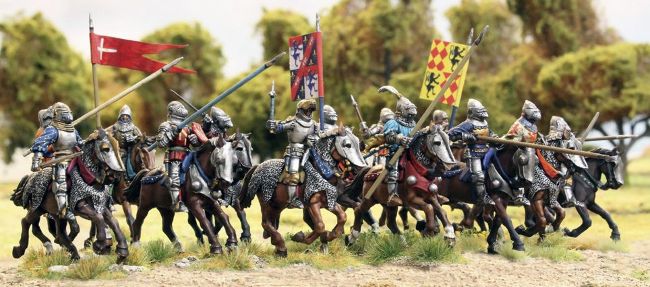
When élan goes wrong! French knights at Agincourt. Photo and figures by Perry Miniatures.