FIRST ON THE MOON
Hundreds of things had to go according to plan for Apollo 11 to land astronauts on the Moon and return them to Earth successfully. The flight proceeded mostly generally as planned, but there were a number of potential missionstoppers that the general public only learned about later.
Rod Pyle
APOLLO 11’S DANGEROUS MISSION
The story of humanity’s first visit to another world is one that is well known. But this grand saga, one filled with drama and grandeur, often omits many details–the small moments of apprehension, concern, and sometimes even fear–which attended the mission of Apollo 11, carrying the first crew to attempt a landing on the Moon.
COMPUTER ALARM!
Neil Armstrong, Buzz Aldrin, and Michael Collins departed Earth from the Kennedy Space Center on July 16, 1969. Three days later they were in lunar orbit. On July 20, Armstrong and Aldrin entered the Lunar Module (LM), and fired its descent engine to initiate their long fall to Mare Tranquilitatis, dozens of miles below them.
The Apollo 11 Lunar Module Eagle was passing 33,000 feet (about 10,000 meters), headed to the Moon below, when the first alarm went off. The Eagle’s guidance computer had become overloaded and locked up, displaying a numeric error message on its display: “1202.” After a flawless launch, a by-the-numbers transit across 240,000 miles (386,243 kilometers) of space to the Moon, and having braked the Command and Service Module (CSM) Columbia into lunar orbit, a computer malfunction could cause America’s first landing on the Moon to be scrubbed over a few errant electrons.
Neil Armstrong, who was piloting the Eagle, looked at the readout with concern, as Buzz Aldrin, his comrade in this great adventure, continued to watch the computer, as he had been throughout. Neither man knew what the alarm meant—only that it represented a potential mission scrub and could cause them to cut short the landing attempt. Landing on the Moon was not something that could be eyeballed, like setting down at a local airstrip on Earth. If the computer failed, they would have to abort, staging the LM and making an emergency ascent back to Mike Collins and the waiting CSM in orbit, a potentially dangerous maneuver.
“Program Alarm,” Armstrong said, with the slightest edge of tension in his voice. “It’s a 1202.”
The radio signal between the LM and Mission Control had been weak, so Aldrin repeated, “1202.” In Houston, flight controllers scrambled to discern what the 1202 code meant, as nobody had recognized it immediately. Then a call came from a team of engineers in an operations support room adjacent to Mission Control, and Steve Bales, the controller responsible for the navigation computer, told Flight Director Gene Kranz that it was okay to proceed. Relieved but still concerned, Kranz assented.
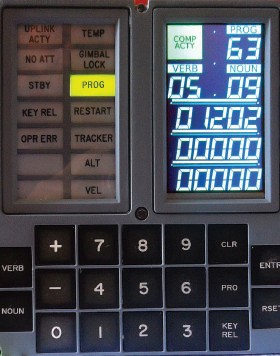
What the 1202 computer alarm looked like to Armstrong and Aldrin aboard the Lunar Module. This is a modern reproduction of the Apollo Guidance Computer.
Nick Howes
Armstrong continued the descent, taking manual control of the Eagle and concentrating on the cratered landscape that was passing below them. Aldrin kept his eyes on the computer display, giving a running account of the readout. The machine locked up a few more times, with both “1202” and “1201” errors, but these were determined to be non-critical, and the landing continued. These computer interrupts were designed to keep the guidance computer from shutting down in the event of a data overload—which it was now experiencing—and told the machine to disregard non-critical duties and concentrate on only the most necessary ones.
Most people listening on radios and televisions across the world didn’t have any idea that there had been a serious risk of an abort due to a balky computer. Even fellow astronaut Wally Schirra, who was sharing the commentating duties with news anchor Walter Cronkite at CBS News, fumbled a question from Cronkite; he had no real idea what it was either.
FUEL LEVEL: CRITICAL
By now Armstrong also realized that they were way off target— nothing he saw below matched the lunar maps that had been painstakingly generated over the years from robotic orbiters and the two Apollo missions that had preceded them to the Moon. They were “landing long” in pilot’s parlance, and had overshot the planned landing zone. Analysts would later determine that a small amount of air in the docking tunnel between the CSM and LM had given the lander a bit of extra push upon undocking, which added to their velocity in orbit. The result of that gentle nudge was that as the duo neared the lunar surface, Armstrong was no longer searching for the planned landing site; he was searching for any safe landing site, and fuel was draining quickly.