GB
  
You are currently viewing the United Kingdom version of the site.
Would you like to switch to your local site?
16 MIN READ TIME

Not So Hidden:

Ten Unsung Heroes of Apollo
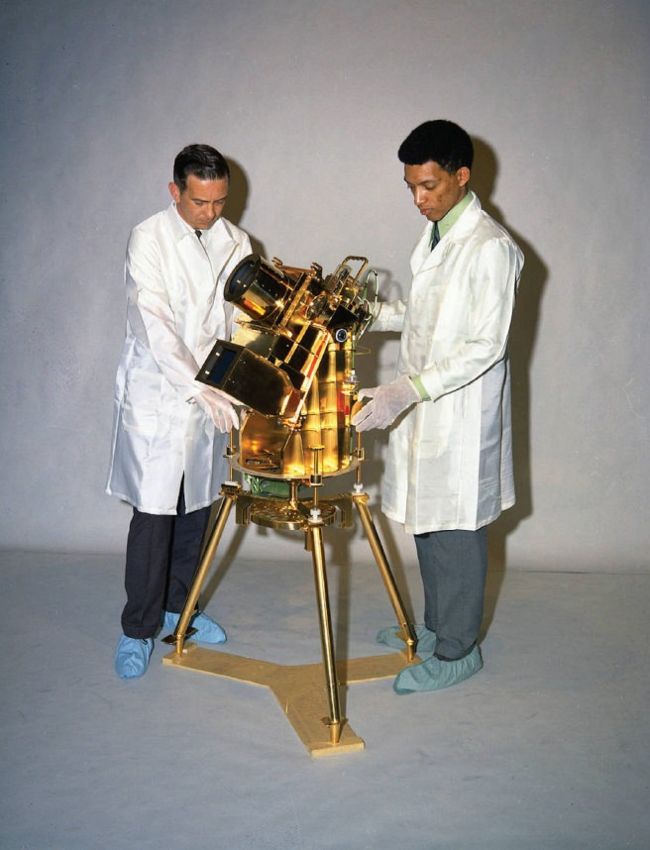
Dr. George Carruthers, right, and William Conway, a project manager at the Naval Research Institute, examine the gold-plated ultraviolet camera/spectrograph, the Moon-based observatory that Carruthers developed for use on the Apollo 16 mission.
NASA

“[Apollo 11] was a perfect example of teamwork. Thousands of people [were] working on an unprecedented project like that, and nothing serious went wrong.”

- Neil Armstrong, on a 1983 “Bob Hope’s Salute to NASA” television special

Of the nearly half-million Americans who worked on the Apollo project, we hear mostly about the astronauts and key figures in Mission Control. But behind these noteworthy people were countless more from varied walks of life that are far less heralded. Here are profiles of ten of these exceptional people.

This past December, the spaceflight community celebrated the 50th anniversary of NASA’s iconic Apollo 8 mission, in which humans orbited the Moon for the first time. During 2019, more Apollo anniversaries will continue, leading to July’s remembrance of Apollo 11.

During these months, famous names will be discussed in countless documentaries, books, and articles commemorating these milestones; astronauts Frank Borman, James Lovell, William Anders, Neil Armstrong, Buzz Aldrin, and Michael Collins are just a few. But there are many other men and women who contributed to the successes of Apollo, who never made the journey but were integral to its success.

According to NASA, a workforce of over 400,000 made the Apollo lunar missions possible, from its nascent test phases in the early 1960s to its conclusion in 1972. NASA’s Langley Research Center has stated that the program “required the support of over 20,000 industrial firms and universities.” While it is impossible to profile each of the diverse personalities behind Apollo, here are ten unsung heroes of the program. Though they may have not launched atop a Saturn V, stepped on the Moon, or driven an electric car across the lunar terrain, each pioneered spaceflight in his or her own way. While this list is presented in alphabetical order, each figure—well-known or not—was essential to Apollo’s success.

GEORGE CARRUTHERS

Born in 1939, Dr. George Carruthers was inspired by science fiction and the famous 1952 Dr. Wernher von Braun article “Man Will Conquer Space Soon,” which appeared in “Collier’s” magazine. “[Von Braun] was certainly a role model to me,” Carruthers stated in the book “We Could Not Fail,” written by Richard Paul and Steven Moss. “I wrote him a letter asking him for some information and he sent me an autographed letter as part of his response.” A budding astronomer, Carruthers went on to earn several degrees from the University of Illinois, culminating in a doctorate in aeronautical and astronomical engineering. Shortly afterward, Carruthers was hired as a research physicist at the Naval Research Laboratory in Washington, D.C.

An inventor as well as an astronomer and engineer, Carruthers had secured a patent for a device called the Far Ultraviolet Electrographic Camera. In 1969, he submitted a proposal to NASA; his idea was to place one of his ultraviolet cameras on the lunar surface during an Apollo mission. While another scientist, Thornton Page, had submitted a similar proposal, this did not mark the end of Carruthers’ ambitions. He and Page worked together on the Far Ultraviolet Camera/ Spectrograph telescope.

Read the complete article and many more in this issue of Ad Astra
Purchase options below
If you own the issue, Login to read the full article now.
Single Digital Issue 2019 - 2
 
£5.99 / issue
This issue and other back issues are not included in a new subscription. Subscriptions include the latest regular issue and new issues released during your subscription. Ad Astra

This article is from...


View Issues
Ad Astra
2019 - 2
VIEW IN STORE

Other Articles in this Issue


COMMS
THE YEAR OF APOLLO
As I certainly need not tell you, this year marks a
A Message FROM THE Incoming Chair of the NSS Executive Committee
A Message FROM THE Incoming Chair of the NSS Executive
APOLLO 11
FIRST MAN ON THE MOON
THE REAL
To celebrate the 50th anniversary of the first lunar landing, National Space Society President and “Ad Astra” columnist, Geoffrey Notkin, sat down with his childhood hero, Apollo 11’s Lunar Module Pilot Buzz Aldrin, for an exclusive NSS interview about spaceflight past, present, and future.
INSIDE NEIL ARMSTRONG
JOHN F. KROSS PRESENTS AN EXCLUSIVE INTERVIEW WITH JAMES HANSEN, AUTHOR OF “FIRST MAN”
SETTING THE STAGE
SETTING THE STAGE
Landing humans on the Moon was an enormous undertaking. The massive Saturn V had to be designed, tested and tamed. The Lunar Module had to be developed from whole cloth, and many other machines and systems perfected before the first mission to the lunar surface could be successful. This is the story of that preparation.
CHESLEY BONESTELL:A BRUSH WITH THE FUTURE
Directed and produced by Douglass Sterwart
A COMMANDING PRESENCE: The story of the APOLLO COMMAND MODULE
The Apollo Command Module was a critical component to the lunar missions, and the story of its development-including the tragic tale of Apollo 1—is central to understanding the story of the Apollo program.
A FORGOTTEN FIRST: THE FIRST LIVING CREATURES TO LOOP THE MOON
In the race to beat America to the Moon, the Soviet Union developed two different systems for lunar flight–one for landings, and another for lunar flybys. This story explains how the latter were successfully tested, but came too late to bring the Soviets glory in the space race.
The Apollo Guidance Computer
What would you do with a surplus Apollo Guidance Computer, a true gem of the space age? Here is one man’s quest to revive one such piece of space race history…with a lot of help from like-minded friends.
A MISSION TO THE MOON
Eyewitness TO HISTORY
The mission of Apollo 11 was covered primarily by seasoned, mid-life journalists. But one teenager managed to wrangle a press pass–here is David Chudwin’s account of the events of July, 1969, complete with exclusive photos he took of the events.
FIRST ON THE MOON
Hundreds of things had to go according to plan for Apollo 11 to land astronauts on the Moon and return them to Earth successfully. The flight proceeded mostly generally as planned, but there were a number of potential missionstoppers that the general public only learned about later.
A NEW GENERATION OF APOLLO ART:
Inspirations from the International Association of Astronomical Artists.
THE CHILDREN OF APOLLO
To the children of the Apollo astronauts, growing up in the new suburbs outside the Johnson Space Center seemed normal. Upon later reflection, however, it was anything but ordinary. This book excerpt contains the recollections of Rick Armstrong and Andrew Aldrin.
AND DON’T FORGET… ONE IN THE COMMAND MODULE
While we hear much about the astronauts that walked on the Moon, there was a third crewmember on each Apollo mission that was critical to success: the Command Module Pilot, without whom none of the Apollo missions would have accomplished its goals.
APOLLO’S LEGACY
One Giant, 50-Year Leap:
Imagine an organization with a name recognized in every country in the world, whose every move was watched by hundreds of millions of people, and whose successes fulfilled the dreams of a nation and inspired awe and admiration around the world. This was NASA in the 1960s. How can the space agency revive it’s “brand” in the 21st century?
Op-Ed Caught Between The Moon AND A STEAM CARRIER
The Apollo program encouraged countless young people to enter fields such as engineering, science and math. On this 50th anniversary, it’s time to rekindle that passion.
NSS, ON A MISSION TO THE STARS
NSS Chapters
PROMOTING LUNAR SETTLEMENT
Chat
X
Pocketmags Support