DESTINATION clean air
As global leaders were gathering for a key climate change summit, Tom Batchelor considered some of the options available to the aviation industry to scrub up its act
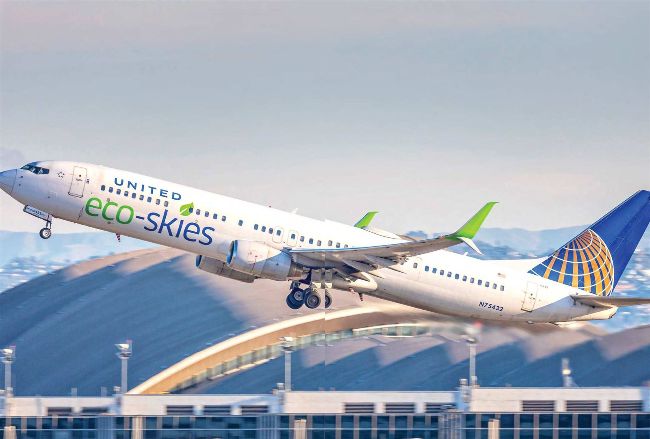
• United Airlines' Boeing 737-900ER, N75432 (c/n 32835) is seen sporting a special eco livery at LAX in March 2021
AIRTEAMIMAGES.COM/DAAN VAN DER HEIJDEN
Pressure is rapidly building on the aviation industry to do more to improve its environmental impact.
With self-imposed deadlines for the sector’s ambitious targets to slash carbon emissions fast approaching, airlines and the wider ecosystem that supports them must turn commitments into action. The task is enormous: according to World Economic Forum research, if the global aviation industry were a country, it would rank in the top ten of greenhouse gas emitters, ahead of nations such as the UK and Brazil. While the industry’s annual contribution to human-made carbon emissions is estimated to be around two per cent, some experts suggest this is an underestimate as emissions have can have a greater impact when released at higher altitudes.
Despite downward revisions caused by the pandemic, passenger numbers are forecast to grow steadily over the coming decades, even in more mature markets. Boeing’s vice-president of commercial marketing forecast in September that European passenger traffic would grow by 3.1% per year over the next 20 years, while other regions could show even stronger growth. Couple this with decarbonisation targets – such as the UK aviation sector aiming to cut emissions by at least 15% by 2030, 40% by 2040, and reach ‘net-zero’ by 2050 – and airlines, manufacturers and airports can spare no time to address the issue.
Grant Shapps, the UK transport secretary has said the country is “leading on decarbonising aviation”, but acknowledged achieving significant emission cuts remained a “huge challenge”.
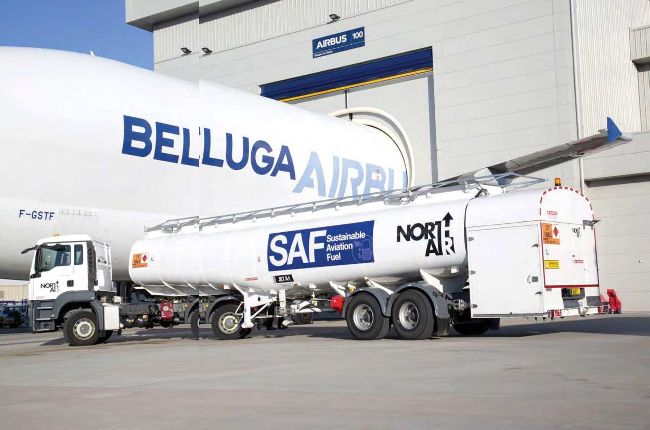
• Earlier this year, Airbus marked the maiden flight of a Beluga super-transporter using SAF from the company’s Broughton plant
AIRBUS
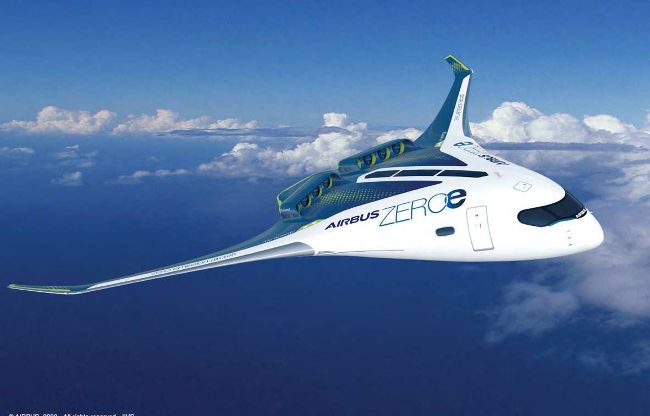
• ZEROe is an Airbus concept aircraft with a blended-wing body configuration and two hybrid hydrogen turbofan engines providing thrust. The liquid hydrogen storage tanks are stored under its wings
AIRBUS
His goal to reach net-zero for aviation by 2050 through a ‘Jet Zero’ initiative includes proposals to improve the efficiency of the entire industry while accelerating the development of sustainable aviation fuels. Rather than simply flying less, it is suggested that the sector’s path to cut its carbon footprint can be a positive one, defined by new technology and innovative ways of thinking. As global leaders were descending on Glasgow for the United Nations Climate Change Conference in early November, Airliner World was looking at challenges and possible solutions that could clean up aviation.
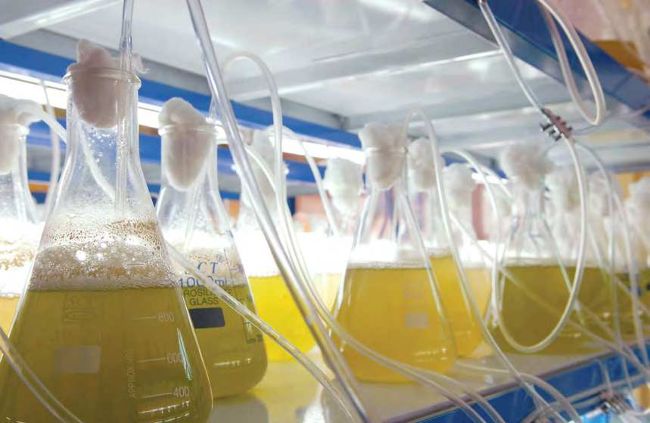
• Could biofuels be an effective medium-term solution?
BOEING
Focus on fuels
Considered by many as a potential short-term game changer, sustainable aviation fuel (SAF) could herald huge carbon savings for airlines with relatively little operational disruption. Made from renewable and waste sources, SAF is the only viable alternative to jet fuel on the market. Compared with conventional sources, SAF can reduce lifecycle emissions by up to 80%, and can be used to power existing aircraft without requiring modifications to either the airframe or engines. When burned, the molecules in SAF produce the same level of emissions, so savings actually come from using alternative feedstocks (the raw material from which fuels are produced) to crude oil, such as cooking and plant oils, municipal waste and agricultural residues.
Speaking to Airliner World, Andreea Moyes, global aviation sustainability director at Air bp, said the role of hydrogen and electric power is being studied, "but for medium and long-range flights, liquid fuels will continue to be the primary way to decarbonise". Moyes explained that even with the introduction of new technologies, fuel efficiencies, updated infrastructure and operational changes, between 50 and 80% of the industry's required emissions reductions needed to come from making fuel more sustainable. One current problem with SAF is the cost: it is four to six times as expensive as conventional jet fuel. Another difficulty is that there is not enough being produced, partly because of the limited supply of feedstocks such as waste oils and beef tallow. Existing producers such as Air bp believe they can get closer to meeting the required output using landfill sources, agricultural and forestry waste or nonbiological sources such as ‘e-fuels’ or power-to-liquid – which relies on renewable power to split hydrogen from water and combine it with carbon from either industrial sources or direct air carbon capture. “When you add up all of these feedstocks, you can satisfy the global aviation fuel demand,” said Moyes.