James Webb Space Telescope
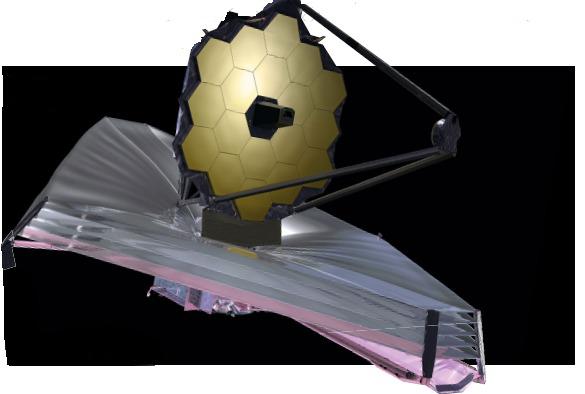
The JWST’s hexagonal mirrors form one big structure
© NASA
THE SPECS
Launch: November/December 2021
Launch rocket:Ariane 5 ECA
Target: Sun-Earth L2 point
Operators: CSA, ESA, NASA and STScl
Orbital inclination: Halo orbit
Component: Multiple international components
Planned mission ends: 2031
Focal length: 131.4 metres (431 feet)
Ever since NASA launched the Orbiting Astronomical Observatory 2 spacecraft in December 1968, the scientific world has gazed out into the depths of the universe through many a generation of space telescope. For decades, two observatories have provided the most prolific and in-depth imagery of space: the Hubble and Spitzer space telescopes.
Since its launch in 1990, the Hubble Space Telescope has become an integral part of NASA’s – and, by extension, the wider scientific community’s – understanding of the cosmos, and in conjunction with the infrared capabilities of Spitzer, launched in 2003, our views of the starladen skies around us have changed forever.
But like any great pioneer or innovator, the older telescopes must eventually step aside to make way for a new wave of scientific developments. And it’s in the James Webb Space Telescope – named after James E. Webb, the second administrator of NASA, who helped redefine the vision of the early Space Race – that the American space agency is placing its hopes and dreams. With its 6.5-metre (21.3-foot) diameter segmented mirror, the new primary telescope will provide a whole new level of clarity to spacecaptured imagery.