NEPTUNE
The isolated azure giant remains a relative mystery
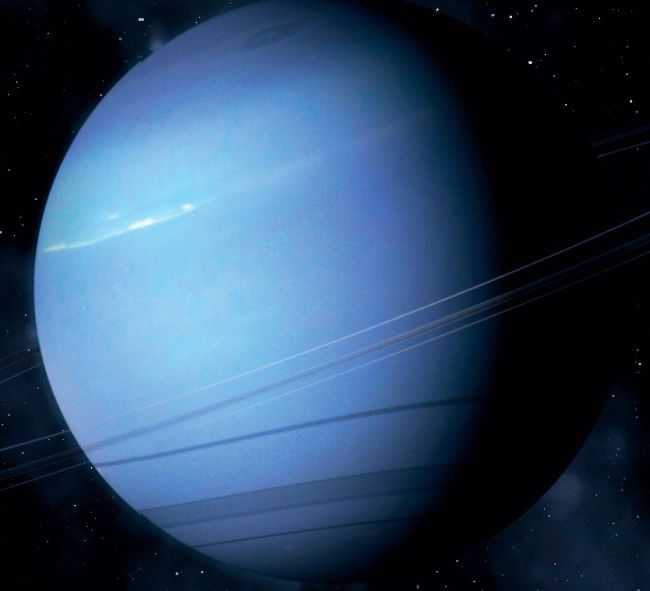
© Getty
Neptune is the eighth planet from the Sun. It was the first planet to have its existence predicted by mathematical calculations before it was actually seen through a telescope on 23 September 1846. Irregularities in the orbit of Uranus led French astronomer Alexis Bouvard to suggest that the gravitational pull from another celestial body might be responsible. German astronomer Johann Galle then relied on subsequent calculations to help spot Neptune via telescope. Previously, astronomer Galileo Galilei sketched the planet, but he mistook it for a star due to its slow motion. In accordance with all the other planets seen in the sky, this new world was given a name from Greek and Roman mythology: Neptune, after the Roman god of the sea.
Only one mission has flown by Neptune – Voyager 2 in August 1989 – meaning that astronomers have done most studies using ground-based telescopes. Today there are still many mysteries about the cool, blue planet, such as why its winds are so speedy and why its magnetic field is offset. While Neptune is of interest because it is in our own Solar System, astronomers are also interested in learning more about the planet to assist with exoplanet studies. Specifically, some astronomers are interested in learning about the habitability of worlds that are somewhat bigger than Earth.