GREGORY LEONARD
“WE DO OCCASIONALLY STUMBLE INTO UNKNOWN COMETS”
Comet Leonard’s discoverer explains how the unusual object was found – and what it’s told us about these dirty snowballs
Interviewed by Samantha Mathewson
© Getty
BIO
Gregory Leonard
Leonard is a senior research specialist at the University of Arizona’s Lunar and Planetary Laboratory. In January 2021 he discovered Comet Leonard – the brightest and most anticipated comet of 2021. The comet was spotted, somewhat accidentally, using the Catalina Sky Survey’s 1.5- metre (60-inch) telescope at the Mount Lemmon Infrared Observatory, located in the Santa Catalina Mountains in Arizona.
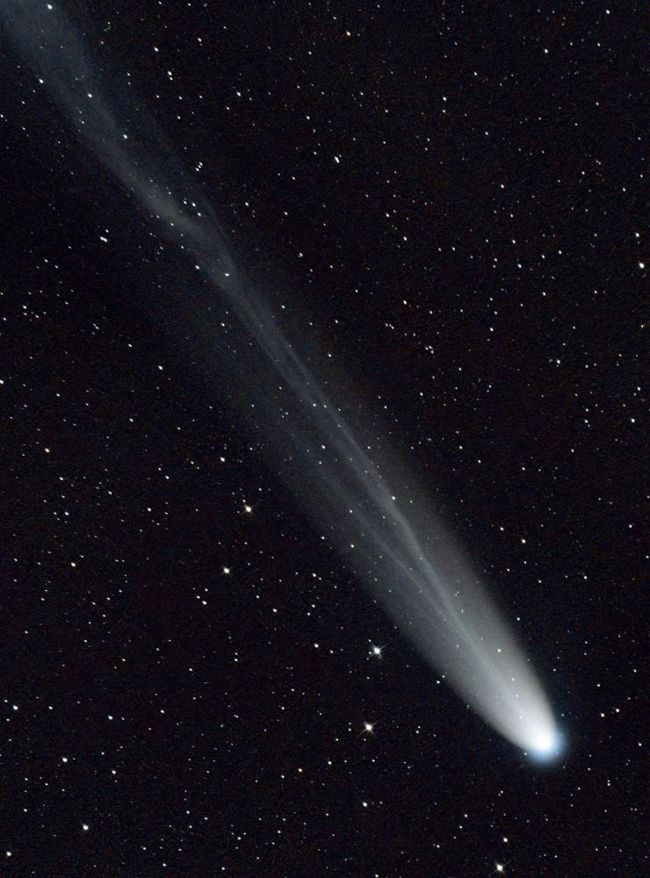
The comet, formally known as C/2021 A1, has since been making its way to the inner Solar System, passing near Earth on 12 December 2021 and Venus on 17 December 2021. On 3 January 2022, Comet Leonard reached perihelion – the closest approach to the Sun in its orbit – at a distance of roughly 90 million kilometres (56 million miles).

© Catalina Sky Survey/University of Arizona
How did you discover Comet C/2021 A1?
I’m an astronomer with the Catalina Sky Survey, a NASA-funded project based out of the University of Arizona, and we’re directed to discover and track near-Earth asteroids – the kind of asteroids whose orbits can bring them close to Earth and potentially impact the planet. I discovered Comet C/2021 A1 Leonard – also known to the world as Comet Leonard – on the morning of 3 January 2021. It was a serendipitous, or incidental discovery in one of our standard survey fields, looking for near-Earth asteroids.
We do occasionally stumble into unknown comets, and that’s exactly what Comet Leonard was. I saw the object not as a point or star-like object, like most asteroids would appear to us; this one had the telltale fuzzy coma that comets have – the coma is that thin, tenuous atmosphere that forms around the nucleus of a comet when it gets close enough to the Sun to excite and sublimate, or boil off, the ices that the comet is made of. In addition to seeing that thin coma, or that fuzziness around the comet, I also detected a little stubby tail, and that, of course, is another telltale sign that it’s likely a comet.