GB
  
You are currently viewing the United Kingdom version of the site.
Would you like to switch to your local site?
6 MIN READ TIME

USER MANUAL

MARS RECONNAISSANCE ORBITER (MRO)
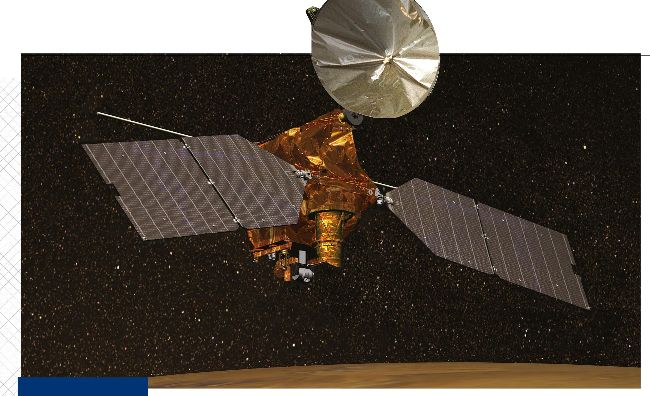
The MRO was launched in response to NASA’s plans to study Mars more thoroughly

THE SPECS

Launch: 12 August 2005 Launch rocket: Atlas V 401

Target: Mars

Operators: NASA and JPL

Orbital inclination: 93 degrees

Component: Multiple components

Arrival at Mars: 10 March 2006

Mission ends: TBC

Time spent in orbit: 16 years

From the fascination it has provided the field of astronomy with for centuries, to the secrets it has yielded since the first Mars mission in 1960, the Red Planet remains an elusive and esoteric point in the night sky.

Since the early 1960s, the collective space agencies of the world have launched over 50 missions to the distant world the Romans named after their deity of war. One of those missions – NASA’s Mars Reconnaissance Orbiter (MRO) – has just completed its tenth year of groundbreaking study above Mars. Through the lens of its colossal HiRISE camera, we have been able to study the Red Planet like never before and it has radically changed our understanding of this awe-inspiring destination.

Much like many spacecraft before it (and no doubt, those to come after it), the MRO was born out of NASA’s ever-evolving mission to study Mars in greater depth. After more than a decade of successful launches, NASA’s longstanding Mars Exploration Program (MEP) decided it needed a powerful camera, designed specifically to study Mars’s unusual topography and composition.

Unlock this article and much more with
You can enjoy:
Enjoy this edition in full
Instant access to 600+ titles
Thousands of back issues
No contract or commitment
Try for 99p
SUBSCRIBE NOW
30 day trial, then just £9.99 / month. Cancel anytime. New subscribers only.


Learn more
Pocketmags Plus
Pocketmags Plus

This article is from...


View Issues
All About Space
Issue 133
VIEW IN STORE

Other Articles in this Issue


All About Space
WELCOME
ISSUE 133 We’re heading into late summer, and
Mysterious fast radio bursts could reveal hidden matter around galaxies
An artist’s impression of a fast radio burst
magazines direct
www.magazinesdirect.com
WHAT’S IN THE SKY?
What to look out for during this observing period
ALL ABOUT SPACE
Future PLC Quay House, The Ambury, Bath, BA1
LAUNCHPAD
Webb’s first deep field
New James Webb image releases © NASA, ESA,
Carina Nebula
New James Webb image releases © NASA, ESA,
Stephan’s Quintet
New James Webb image releases © NASA, ESA,
Southern Ring Nebula
Webb’s second image displays the Southern Ring Nebula.
Chinese project will bounce signals off asteroids to see how dangerous they are to Earth
A leading Chinese university has begun constructing an
Higgs boson behaves just as expected, ‘comprehensive studies’ confirm
The ATLAS instrument at CERN’s Large Hadron Collider
Mars spacecraft may have to dig deeper than thought to find traces of life
Mars rovers may have to dig deeper to
ALIEN STORMS
INCREDIBLE WEATHER ON OTHER WORLDS IS OUR SUN BECOMING MORE DEADLY? WHAT CAUSES THEM
DUST STORMS THAT COVER THE PLANET
Now, this is really bad weather – adust
HURRICANES BIGGER THAN EARTH
Easily one of the most famous storms in
THE VIOLENT POLAR VORTEX
Around once every Saturn year (roughly 30 Earth
DEADLY METHANE RAIN
With a surface pressure almost one and a
WINDS AT TWICE THE SPEED OF SOUND
We’ve all witnessed strong winds here on Earth,
FUTURE TECH
GAMMA-RAY OBSERVATORY
This far-sighted next-generation telescope array may help answer some of the universe’s biggest mysteries
INTERVIEW
“Dicke put the phone down and said… ‘Boys, we’ve been scooped!’”
When radiation left over from the heat of the Big Bang was discovered by astronomers Robert Wilson and Arno Penzias in 1964, it caused a revolution in cosmology. All About Space catches up with the Nobel prizewinning Wilson to uncover just how much
FOCUS ON
NASA’S DART MISSION MIGHT COMPLETELY DEFORM SMALL MOONLET
A new study finds that the spacecraft’s impact could be stronger than expected
20 AMAZING FACTS ABOUT THE UNIVERSE
From the size of hypergiant stars to the weird effects of space travel on the human body, prepare to have your mind blown by the awesome cosmos we live in
GAMMA-RAY BURSTS MIGHT BE MUCH RARER THAN WE THOUGHT
Simulations of black hole birth are unlocking the secrets of these bright-light phenomena
THE SEARCH FOR WORMHOLES
All About Space joins the teams of scientists searching for wormholes in an attempt to uncover the facts behind the science fiction
WEBB TELESCOPE TO GET BEST VIEW YET OF FAILED STARS AND ROGUE WORLDS
Not much is known about these tiny celestial bodies, which are hard to see
DID SCIENTISTS IN CHINA REALLY RECEIVE SIGNALS FROM ALIENS?
Chinese researchers reported three suspicious signals, potentially from an extraterrestrial civilisation… then the report was pulled
How will Earth end?
Earth has bounced back after disasters in the
BACKYARD ASTRONOMY ON A BUDGET
All About Space brings you all of the fun of astronomy without breaking the bank
INSTANT EXPERT
HOW MANY TYPES OF SPACE STATION ARE THERE?
The ISS is the largest and best-known space station, but it is not the first or the last in space
MAP THE MARTIAN SURFACE
1 Providing some context The MRO uses the
STARGAZER
PLANETARIUM
ILLUMINATION PERCENTAGE PLANET POSITIONS A
THIS MONTH’S PLANETS
Mars prepares for opposition in the summer sky, while the gas planets will also be an easy catch in the evening
ERATOSTHENES CRATER
Make the most of this welldefined asteroid impact
NAKED EYE AND BINOCULAR TARGETS
Summer skies are full of celestial wonders, particularly in Cygnus and Aquarius
DIVING DEEP INTO THE SUMMER SKY
Find the ghostly remains of dead stars, glittering ancient star clusters and a spectacular distant galaxy
THE NORTHERN HEMISPHERE
Galaxies and globular clusters are easy pickings with binoculars and telescopes
ASTROSHOTS OF THE MONTH
California Nebula (NGC 1499) Location: Colorado Telescope: Takahashi
MOVE SHOOT MOVE STAR TRACKER
A perfect place to start for aspiring astrophotographers, but how does it hold up in real life?
IN THE SHOPS: LEGO SETS
Pick your next set from this excellent space-themed selection
HEROES OF SPACE
GALILEO GALILEI
The father of modern astronomy provided the basis for our understanding of the Solar System
Chat
X
Pocketmags Support