REVIEW
MOVE SHOOT MOVE STAR TRACKER
A perfect place to start for aspiring astrophotographers, but how does it hold up in real life?
Reviewed by Dave Stephenson
A tjust £205.99 ($249), the Move Shoot Move star tracker is more or less the cheapest star tracker on the market. Weighing in at only 450 grams, it’s also one of the lightest, allowing fleet-footed astrophotographers to bring it with them even if weight is a consideration. But with other entry-level star trackers coming in at nearly double the price, the hunt for compromises is on: how does the Move Shoot Move stack up against the competition?
The Move Shoot Move star tracker is a compact little thing, which forms a huge part of its appeal. Compare it to the likes of the Sky-Watcher Star Adventurer 2 – pricier, but admittedly with a few more talents – and you’ll see what we mean. The Move Shoot Move tips the scales at just 450 grams, which combined with its size of 4.3 by 8.1 by 9.9 centimetres (1.7 by 3.2 by 3.9 inches) makes it genuinely pocketable.
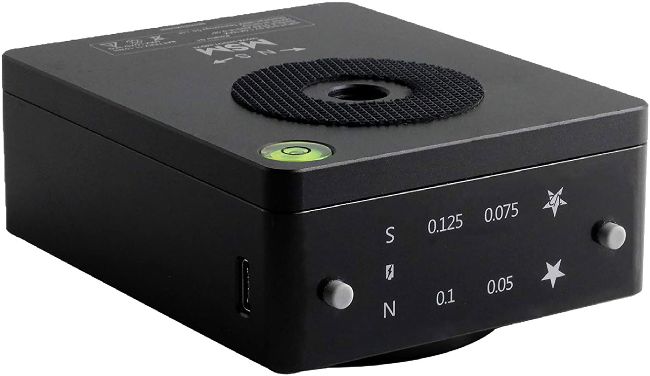
It’s small and portable for astro on the go
It has a simple-looking design. Made of tough-feeling metal, the top disc – the bit that rotates – has a grippy circle of rubber on it to minimise slipping, while the front has just two buttons. One powers the unit on and off and can also be used to let it know which hemisphere of Earth it’s in, while the other varies how quickly the Move Shoot Move star tracker rotates. You get the option of what we came to call ‘normal’, in which the Move Shoot Move matches the rotation of Earth for steady long exposures, and half-speed, which allows much longer rather than theoretically indefinite wide-angle exposures of the Milky Way. There’s also the option to set the Move Shoot Move up to provide 0.125, 0.1, 0.075 and 0.05 degrees of movement, allowing you to shoot time-lapses with rotations in between them.