ASK SPACE
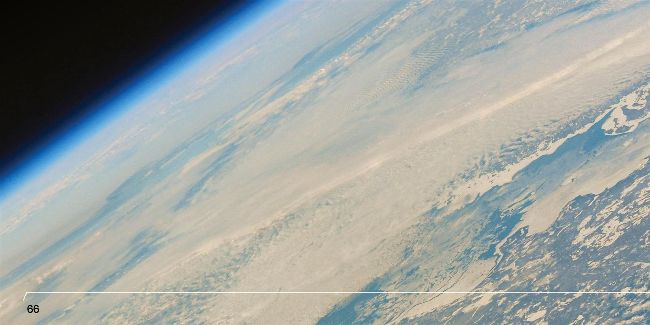
Earth as seen from the International Space Station
Why is space dark?
COSMOLOGY
The darkness of our night sky tells us more about the size, age and nature of the universe than we may expect. We are familiar with the twinkling of nearby stars in the night sky, but why does the night sky not glow with the colour and brightness of the average star? If the universe is infinite in size and age, then in every direction we look there should be a star or galaxy – well known to be powerful emitters of visible light. This puzzle is known as Olber’s paradox after 19th-century German astronomer Heinrich Olbers, and has attracted many attempts to resolve.
The first part in resolving this paradox is that the universe must have a finite age. This means only a finite number of stars can be observed from Earth in any direction, something which is true even if the universe itself has infinite size. The second part is from the expansion of the universe, an integral part of our understanding of cosmology known as the Big Bang model. This expansion of space, together with a finite light travel time, causes the radiation emitted in this hot, dense beginning, as well as that from distant stars and galaxies, to be shifted to longer wavelengths than are visible to the naked eye. We observe this today as the cosmic microwave background – the faint glow of emission over the entire sky, observable only with microwave detectors such as the European Space Agency’s (ESA) Planck mission. Ultimately, the night sky is dark to us due to the expanding, evolving and finite age of the universe.