GB
  
You are currently viewing the United Kingdom version of the site.
Would you like to switch to your local site?
11 MIN READ TIME

EARTH’S SUPER TELESCOPES

Take a tour of the world’s greatest instruments, bringing the universe closer than ever before

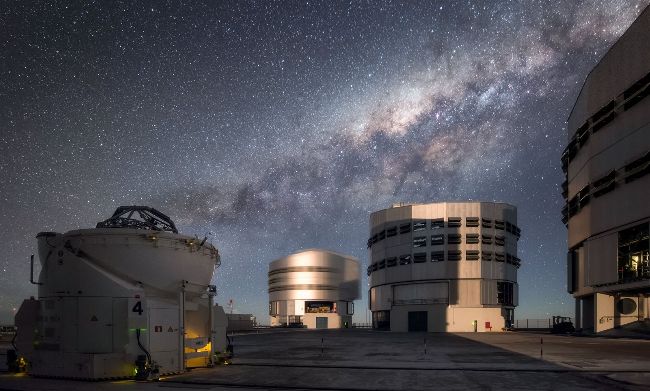
Three of the four telescopes that comprise the VLT at Paranal Observatory in Northern Chile

While space-based telescopes like the James Webb Space Telescope and the Hubble Space Telescope often dominate W the headlines, humanity’s understanding of the Solar System, our galaxy and the wider universe have been massively influenced by telescopes that are firmly rooted on terra firma. Often, these telescopes are located at the summits of mountains, high above Earth’s weather systems, thus limiting the impact of our planet’s atmosphere on observations of the universe. Sometimes they are located in remote regions where the electromagnetic buzz of our species doesn’t obscure radiation from celestial sources. Indeed, some of these instruments would confuse and challenge even the person who first patented the telescope in 1608, Hans Lippershey, not just with their immense scale but also with their outlandish appearance. All About Space celebrates the somewhat unsung super telescopes, telescope arrays and observatories on Earth that have revolutionised our view of space.
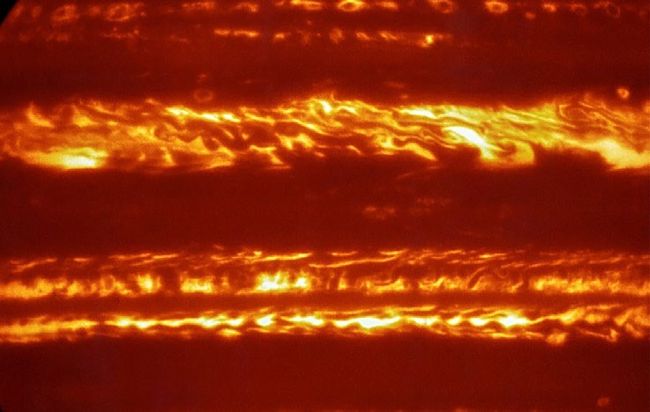
The Very Large Telescope snapped a fiery-looking Jupiter in 2016
© ESO

VERY LARGE TELESCOPE

First light: 1998

Location: Cerro Paranal in the Atacama Desert, Chile Type: Visible light Diameter: Four Unit Telescopes with 8.2-metre (26.9-foot) diameter main mirrors and four movable 1.8-metre (5.9-foot) diameter auxiliary telescopes

The Very Large Telescope (VLT) is billed as the world’s most advanced visible-light astronomical observatory and is the flagship facility for European ground-based astronomy. The four main telescopes of the VLT are named Antu, Kueyen, Melipal and Yepun, and they come together as a giant interferometer. The four telescopes can also be operated independently. One of the four telescopes of the VLT is capable of seeing faint astronomical objects with a visual magnitude of +30.0 in just an hour of viewing time. To put that into perspective, the faintest objects that can be seen with the naked eye are 4 billion times brighter than this. This means the VLT gives astronomers a precise and deep view of the cosmos.

Unlock this article and much more with
You can enjoy:
Enjoy this edition in full
Instant access to 600+ titles
Thousands of back issues
No contract or commitment
Try for 99p
SUBSCRIBE NOW
30 day trial, then just £9.99 / month. Cancel anytime. New subscribers only.


Learn more
Pocketmags Plus
Pocketmags Plus

This article is from...


View Issues
All About Space
Issue 154
VIEW IN STORE

Other Articles in this Issue


ALL ABOUT SPACE
ALL ABOUT SPACE
Future PLC Quay House, The Ambury, Bath, BA1
WELCOME
WELCOME
ISSUE 154 
LAUNCHPAD
The Milky Way’s star-studded core
12 February 2024 
The Sun’s surface rages as solar maximum approaches
13 February 2024
A starry ‘tail’ of 12 mingling galaxies
9 February 2024 
A cosmic ‘tug of war’ between galaxies
31 January 2024
Three tiny new moons found around Uranus and Neptune
Three new moons were detected around the distant
‘Intruder’ stars have changed Earth’s climate over aeons
© Getty Stars intruding into the Sun’s cosmic
A VR headset on the ISS really makes a difference for astronaut exercise
Astronauts can now get a bit of simulated
The brightest quasar ever seen is powered by a black hole that eats a Sun a day
The light around black holes is caused by
Scientists say two Solar System dwarf planets may harbour underground oceans
Two dwarf planets within our Solar System, Eris
‘Quantum gravity’ could help unite quantum mechanics with general relativity at last
Gravity breaks down on the smallest scales ©
KING of the SOLAR SYSTEM
JUPITER IS THE BIGGEST PLANET IN OUR SOLAR SYSTEM BY FAR . HERE’S SOME ESSENTIAL FACTS ABOUT OUR COLOSSAL NEIGHBOUR
FUTURE TECH
SATELLITE REPAIR DROIDS
What do you do when a satellite breaks down? Send in the robots
INTERVIEW
“The most dangerous spacewalk”
We catch up with NASA astronaut Scott Parazynski, the only person in the world to both go into space and conquer Mount Everest
FOCUS ON
SOLAR MAXIMUM MAY HELP SOLVE THE SUN’S GAMMA-RAY PUZZLE
Data gathered during the last solar maximum tells a story of high-energy gamma radiation outpouring from our star’s poles
BABY EXOPLANETS MIGHT LOOK LIKE SMARTIES CANDIES RATHER THAN SPHERES
Newly forming planets in protoplanetary discs around distant stars have been found to resemble colourful candies in a new simulation
A HIDDEN MOON MAY HOLD TOGETHER THE RINGS OF A COMET-LIKE OBJECT BETWEEN JUPITER AND NEPTUNE
The narrow rings around Chariklo, the largest known centaur, could be maintained by an unseen moonlet
THE GEMINID METEORS MAY BE TEN TIMES OLDER THAN WE THOUGHT
The comet-like asteroid Phaethon likely lobbed thousands of rocky fragments towards Earth 18,000 years ago
SATURN’S MOON TITAN MAY NOT BE ABLE TO SUPPORT LIFE AFTER ALL
Titan’s ocean has a volume 12 times that of all Earth’s oceans, but it may be barren of life as we know it
WHERE IS EVERYBODY?
MYSTERIES OF THE UNIVERSE
SIGNS OF INTELLIGENT LIFE
What are SETI researchers looking for when they focus their attention on a potentially habitable planet?
SEARCHING FOR EARTH’S TWIN
NASA astrophysicist Knicole Colón discusses the space agency’s desire to find signs of life
WATER FOUND ON THE SURFACE OF AN ASTEROID FOR THE FIRST TIME
Scientists made the discovery using data gathered by NASA’s nowretired airborne observatory
ASK SPACE
Earth as seen from the International Space Station
AN ‘ODD COUPLE’ OF KISSING STARS CREATED BY A CANNIBALISTIC FEEDING DANCE
A new discovery reveals the origins of rapidly spinning Be stars and their tiny subdwarf companions
BECOME AN ASTRONOMER
Part two
STARGAZER
WHAT’S IN THE SKY?
What to look out for during this observing period
THIS MONTH’S PLANETS
The king of the Solar System will be the focus of many astronomers this spring
ARISTOTELES, EUDOXUS AND MONTES CAUCASUS
This month affords the opportunity to observe some of the Moon’s most prominent craters and mountain ranges
SPRING IN THE GREAT BEAR
This is the perfect time to swing your telescope up to point almost overhead to spot some of the treasures hiding within Ursa Major
NORTHERN HEMISPHERE
Some bright stars of winter still linger after sunset
CELESTRON ASTROMASTER 130EQ
This reflector is great for observing the planets and bright sky objects, but absolute beginners will require patience with its mount
IN THE SHOPS: BEST TELESCOPE MOUNTS OF 2024
Sky-Watcher EQ5 Deluxe Mount and Tripod Cost: £329
SUBRAHMANYAN CHANDRASEKHAR
The man who unlocked the secrets of stellar evolution
Chat
X
Pocketmags Support