BECOME AN ASTRONOMER
Part two
Take your interest a level further by getting to know your telescope and the amazing variety of objects that it reveals
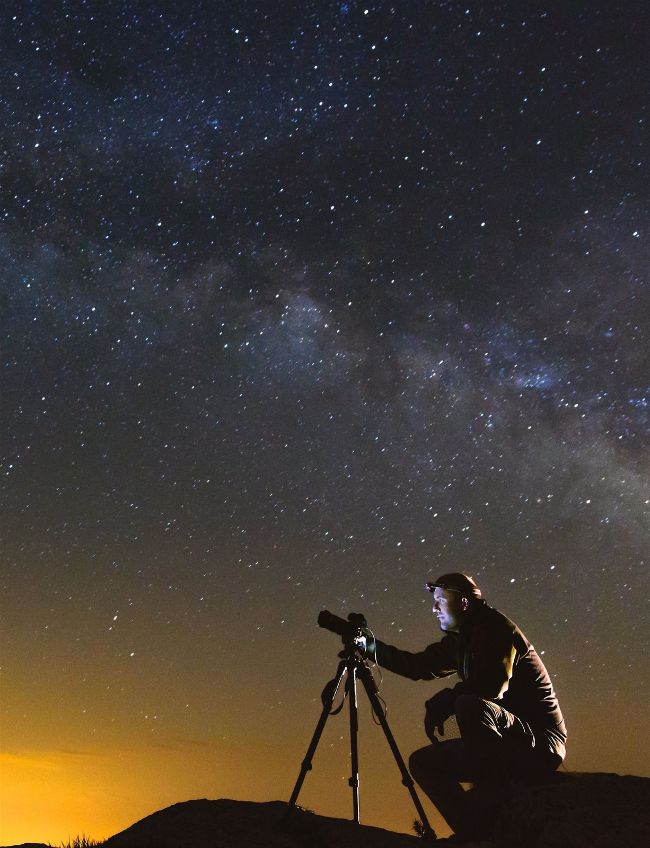
Arich, diverse and rewarding selection of celestial delights await those who take the time to get to know the night A skies. Last issue we saw how you can take your first steps in exploring the amazing variety of objects and phenomena visible in the skies. Here we look more closely at the practical side of being an active astronomer. Once you’ve learned the main constellations visible from your location throughout the year, noting the constant position of the north celestial pole, you’ll soon familiarise yourself with the apparent movement of the celestial sphere and the slow seasonal procession of the constellations as they drift from west to east, hour by hour and day by day. You’ll also notice that as the Moon and planets drift among the stars, they stick pretty closely to the zodiacal constellations of Aries, Taurus, Gemini, Cancer, Leo, Virgo, Libra, Scorpius, Sagittarius, Capricornus, Aquarius and Pisces. Running through these constellations is a line known as the ecliptic, the apparent annual celestial path followed by the Sun. Since the Moon and planets orbit the Sun in roughly the same plane, they follow the same general path among the stars.
The Moon is big enough and bright enough to be enjoyed through any instrument. Of the Solar System’s eight recognised planets, five of them are bright enough to be easily viewed through even a small telescope. Each planet reveals a small illuminated disc that shows surface or atmospheric detail. A familiarity with the appearance of the sky’s main constellations and the bright stars that some of them contain can be gained by using a good planisphere, star chart or computer program. As your confidence in identifying the main constellations, bright stars and smaller patterns, known as asterisms, grows, you will become aware of a number of deep-sky objects – exotic, far-away delights like star clusters, multiple stars, clouds of dust and gas known as nebulae and other galaxies that lie far beyond our own Milky Way.
Virtually every astronomer begins their celestial quest by sampling the best and brightest delights on offer in the night skies, grounding themselves in the reality of what can – and can’t – be seen through their very own telescope from their own particular observing spot.
GETTING TO KNOW YOUR TELESCOPE
From our own cosmic backyard to objects far beyond our galaxy, your instrument will reveal countless wonders of the night sky
The larger a telescope’s aperture, the more light is collected and the more detail is revealed. Telescopic magnification depends on the telescope’s focal length and the focal length of the eyepiece. Magnification is calculated by dividing the telescope’s focal length by the focal length of the eyepiece.
The range of useful magnification depends on aperture and the focal length of both the telescope and the eyepiece. Too low a magnification will waste light, as the ‘exit pupil’ of the eyepiece will be larger than the diameter of the pupil of your dark-adapted eye. As an average, an adult pupil will dilate to seven millimetres (0.3 inches) in dark conditions. Therefore the exit pupil delivered by an eyepiece ideally needs to be smaller than this, especially when viewing faint objects, so that the telescope can take in all the light. Exit pupil can be calculated by dividing the telescope’s aperture by the magnification of the eyepiece.
Equatorial mounts allow celestial objects to be tracked as they appear to move across the sky, but they require initial alignment with the celestial pole. Once the polar axis is aligned, an astronomical object centred in the field can be kept there by manually moving the telescope from east to west in pace with the apparent movement of the sky. With a standard German equatorial mount, ensure that your telescope is properly balanced, adjusting counterweights to balance the weight of your telescope. Loosen the axes clamps on the telescope and ensure the telescope’s weight is centred on its own axis. Once the right balance is found, it should respond to a light touch in the desired direction without tipping of its own accord.