A big noise
One of the first white South African entertainers to speak out against Apartheid, Pieter-Dirk Uys tells Attitude about his brand of satire, playing dress-up and meeting Nelson Mandela
Words Tim Heap
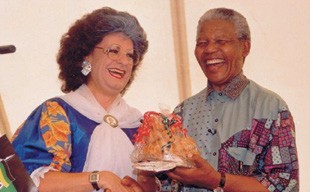
YOU’RE HAVING A LAUGH: “Evita” with South African president Nelson Mandela
satirist Pieter-Dirk Uys has an interesting way of looking at the future. “I’ve always believed that there is a light at the end of the tunnel, but the tunnel is curved, he says. “We may not see the light, but it’s there — you just have to go around the corner and you’ll find it.”
It’s a typically “Uysian” response, I come to realise after speaking to the 72-year-old South African, whose measured words impart wisdom and wit garnered over the course of his life and career — no matter what the subject matter. All of which bodes well for audiences heading to see his new show, The Echo of a Noise at London’s Soho Theatre in June.
Explaining how the show — a sort of live telling of a memoir, without the characters he’s often channelled his satire through — came to be, Pieter-Dirk says, “I never thought I’d have the courage to just tell a story.
“I’ve always been so busy writing characters and using impersonations and familiar monsters, and I suddenly thought, ‘Let me just sit around and tell a story, about growing up and fighting these monsters, and sometimes winning, but not always’. And I think the story of a life is a story we all share, even if the shades and the smells of it are dictated by different cultures.” But Pieter-Dirk’s 40-plus years in the industry came about almost accidentally. He was “highjacked by the theatre”, as he puts it, when he stumbled across the drama department while at university, studying to be a teacher. Although not part of his plan at the time, the heady world of entertainment wasn’t too much of a stretch, born as he was to concert pianist parents, an occupation that’s also shared by his sister. “I was too lazy to play the piano”, he recalls, “and in fact I was often left behind, sitting in the audience while my three family members played on stage with an orchestra.” His father was an Afrikaner, and his mother a German Jew -— a fact that only came to light after she died.