STARGAZER
OBSERVER’S GUIDE TO THE PLANETS
Your guide to getting the best views of the Solar System
VENUS
Being between Earth and the Sun gives Venus – the brightest planet – its famous phases
Being the closest planet to us, it’s no surprise that Venus is such an easy target to find in the sky. However, that doesn’t tell the whole story. Due to its highly reflective atmosphere, Venus is considerably brighter than it should be, only outshone by the Sun and the Moon in the sky. The planet is enveloped in clouds of sweltering carbon dioxide laced with sulphuric acid that trap in a lot of the heat it receives from the Sun. With temperatures often tipping 460 degrees Celsius (860 degrees Fahrenheit), this runaway greenhouse effect makes Venus the hottest planet in the Solar System, even though it doesn’t lie closest to the Sun.
Although not a star itself, Venus has long been known as the ‘morning star’ or ‘evening star’. However, Venus’ unique appearance differs in one striking way from a star – it doesn’t twinkle. Stars twinkle thanks to Earth’s atmosphere. They are so far away from us that we can only ever see them as tiny pinpricks of light. If a pocket of atmospheric dust and gas moves in front of that light, it can temporarily block it out entirely, meaning that from our perspective the stars seem to flicker on and off. Planets, however, are so much closer to us – being in the Solar System – that they actually appear as discs in the sky whose reflected light can never be blocked out entirely.
If you have a pair of binoculars, it’s well worth pointing them towards Venus to see that disc up close. As always with binoculars, setting them up on a photographic tripod will give you a more stable view than the wobbling caused by holding them by hand. Looking at Venus, you should easily make out one of the most famous sights in astronomy: the phases of the second planet from the Sun. As it orbits closer to the Sun than we do, the amount of light Venus reflects towards us changes – in this sense it’s similar to the phases of the Moon. When the planet lies far from the line between the Sun and Earth, we see phases akin to a first quarter and last quarter Moon, with the planet half illuminated. This point, known as greatest elongation, happens twice in Venus’ 225-day orbit.
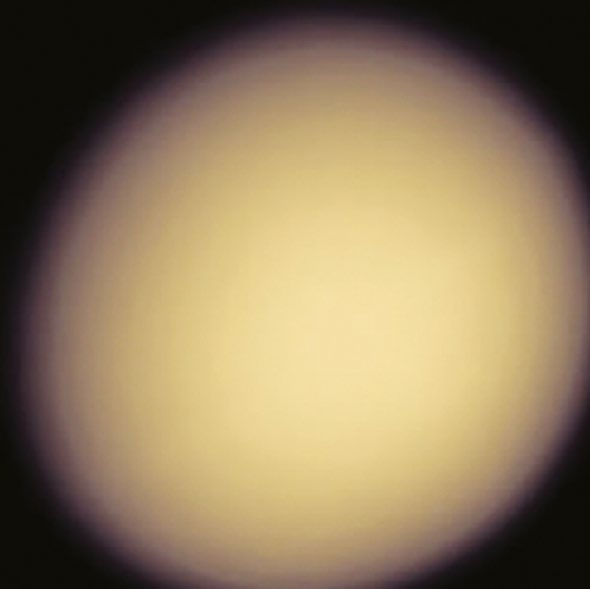
Venus’ phases are evident when observing it
© NASA
“Venus has long been known as the ‘morning star’ or ‘evening star’”
By observing the phases of Venus you will be following in a long line of astronomical greats, most notably Galileo Galilei. The Italian astronomer was the first person to see the changing shapes of Venus in the early 17th century, immediately realising that it vindicated Copernicus’ heliocentric idea that Earth orbited the Sun and not the other way around. Only if both Earth and Venus were circling the Sun, with Venus closer in than us, would we see this effect. That sounded the death knell for Ptolemy’s geocentric idea that Earth was at the centre of the Solar System.