Ask Space
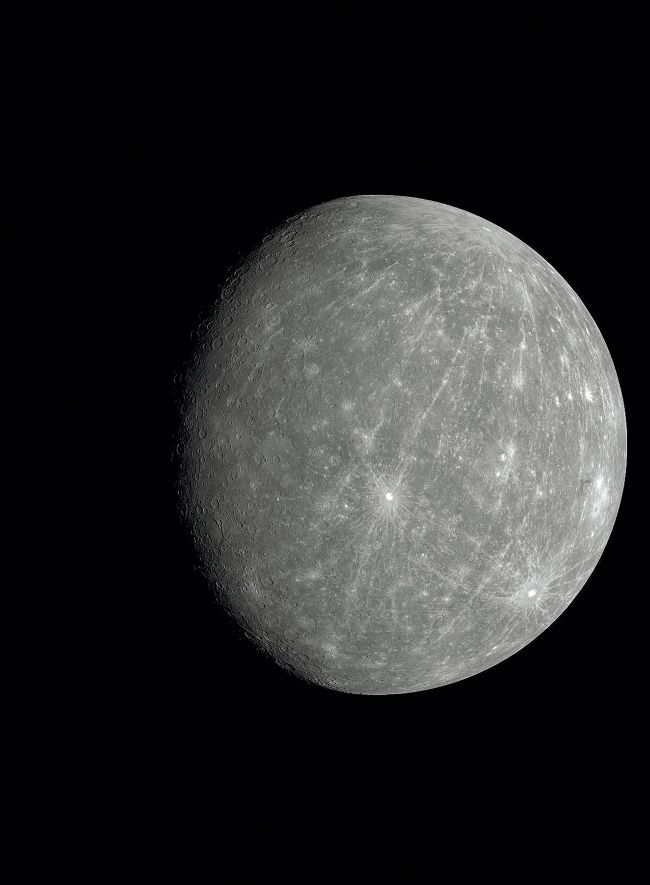
Although some planets have dozens of moons, Mercury and Venus have none
SOLAR SYSTEM
Why don’t Mercury or Venus have any moons?
Planets have a region around them where orbiting objects can be gravitationally bound. In planetary science this is called the ‘Hill sphere’, named after 19th-century American astronomer George Hill, who worked on the Moon’s orbit. The size of the Hill sphere depends on how massive a planet is in comparison to the Sun and how close it is to the Sun. Any bound object must orbit inside the Hill sphere. But for its orbit to be ‘stable’ it needs to orbit at less than about one-third of the radius of the Hill sphere. We expect that all moons must orbit at less than about a third of a Hill sphere radius.
There are other restrictions on where we expect to find moons. Earth’s Moon interacts tidally with Earth – it raises tides on Earth, and that gradually changes the Moon’s orbit. Because Earth spins faster than the Moon orbits – the day is shorter than the month – the effect of this interaction is to move the Moon away from us at a rate of about four centimetres (1.5 inches) a year. A moon in orbit around Mercury or Venus – which spin slowly – would evolve in the opposite direction, with its orbit gradually shrinking. This happens at Mars, where Phobos orbits rapidly with a shrinking orbit and Deimos orbits slowly and much farther away, with an orbit that is growing with time.
So how big are Hill spheres? Venus and Earth are almost twins: similar mass, similar distance from the Sun. The Hill radius of Earth is about 230 Earth radii, for Venus about 166 Venus radii and for Mercury about 72 Mercury radii. For Mercury, it’s pretty clear that there isn’t much room for a moon in the stable region, and if there were it would rapidly fall into the planet due to tidal interactions – the speed with which tides can move moons increases sharply as the moon gets close to the planet.