GB
  
You are currently viewing the United Kingdom version of the site.
Would you like to switch to your local site?
10 MIN READ TIME

Ask Space

Although some planets have dozens of moons, Mercury and Venus have none

SOLAR SYSTEM

Why don’t Mercury or Venus have any moons?

Planets have a region around them where orbiting objects can be gravitationally bound. In planetary science this is called the ‘Hill sphere’, named after 19th-century American astronomer George Hill, who worked on the Moon’s orbit. The size of the Hill sphere depends on how massive a planet is in comparison to the Sun and how close it is to the Sun. Any bound object must orbit inside the Hill sphere. But for its orbit to be ‘stable’ it needs to orbit at less than about one-third of the radius of the Hill sphere. We expect that all moons must orbit at less than about a third of a Hill sphere radius.

There are other restrictions on where we expect to find moons. Earth’s Moon interacts tidally with Earth – it raises tides on Earth, and that gradually changes the Moon’s orbit. Because Earth spins faster than the Moon orbits – the day is shorter than the month – the effect of this interaction is to move the Moon away from us at a rate of about four centimetres (1.5 inches) a year. A moon in orbit around Mercury or Venus – which spin slowly – would evolve in the opposite direction, with its orbit gradually shrinking. This happens at Mars, where Phobos orbits rapidly with a shrinking orbit and Deimos orbits slowly and much farther away, with an orbit that is growing with time.

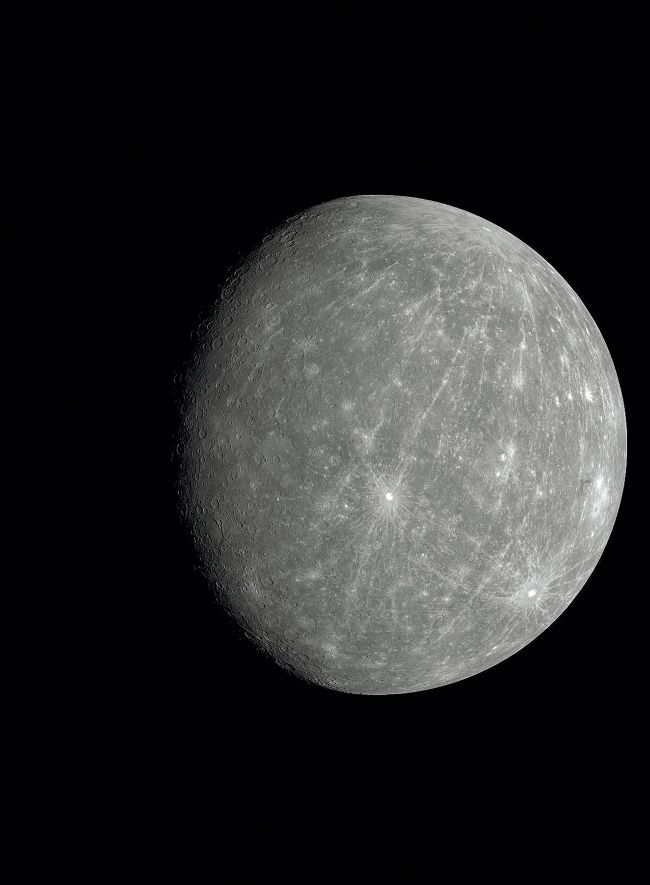
So how big are Hill spheres? Venus and Earth are almost twins: similar mass, similar distance from the Sun. The Hill radius of Earth is about 230 Earth radii, for Venus about 166 Venus radii and for Mercury about 72 Mercury radii. For Mercury, it’s pretty clear that there isn’t much room for a moon in the stable region, and if there were it would rapidly fall into the planet due to tidal interactions – the speed with which tides can move moons increases sharply as the moon gets close to the planet.

Unlock this article and much more with
You can enjoy:
Enjoy this edition in full
Instant access to 600+ titles
Thousands of back issues
No contract or commitment
Try for 99p
SUBSCRIBE NOW
30 day trial, then just £9.99 / month. Cancel anytime. New subscribers only.


Learn more
Pocketmags Plus
Pocketmags Plus

This article is from...


View Issues
All About Space
Issue 161
VIEW IN STORE

Other Articles in this Issue


ALL ABOUT SPACE
ALL ABOUT SPACE
Future PLC Quay House, The Ambury, Bath,
WELCOME
WELCOME
THE FINAL ISSUE
LAUNCHPAD
The Andromeda Galaxy glows rosy red in a gorgeous new image
© NASA The rosy-red structures of a nearby
Hubble spies a very sparkly mini-galaxy
© NASA New images released by NASA’s Hubble
Perseverance begins an ambitious ascent up a Mars crater rim
© NASA NASA’s Perseverance Mars rover has started
The Triangulum Galaxy shines in a new Hubble image
© NASA A nearby galaxy is shining with
A sprinkling of cosmic dust may have helped kick-start life on Earth
Cosmic dust accumulating on Earth could have provided
Starliner astronauts on why their craft returned to Earth without them
Boeing’s Starliner capsule might have been able to
Iron winds and molten metal rain ravage a hellish hot Jupiter exoplanet
WASP-76 b is a burning world with molten
A tiny NASA satellite detects its first massive gamma-ray burst
BurstCube was deployed into orbit on 18 April
NASA’s Juno probe spots a massive new volcano on Jupiter’s moon Io
A comparison of JunoCam data from February 2024
A long -lost moon could explain Mars’ weird shape and extreme terrain
Artist’s impression of Mars and its moons Phobos
THE FINAL FRONTIER
Beyond the reach of the Sun is a fascinating region of the cosmos that we’re only just beginning to explore
FUTURE TECH
KANKOH-MARU
This ambitious reusable spacecraft will be capable of taking 50 people to and from orbit
FOCUS ON
MARS LEAKS FASTER WHEN IT’S CLOSER TO THE SUN
The Red Planet has lost enough water to space to form a global ocean hundreds of kilometres deep
NASA’S SOLAR SAIL SUCCESSFULLY SPREADS ITS WINGS IN SPACE
Spacecraft data has confirmed successful deployment of the futuristic technology
15STUNNING STAR CLUSTERS
These beautiful stellar groupings are spattered across the cosmos
AI IS REVEALING THE UNIVERSE’S ORIGINAL ‘SETTINGS’
Astronomers used artificial intelligence to calculate the five cosmological parameters that describe the entire universe in computer simulations with unprecedented precision
HOW TO BEAT LIGHT POLLUTION
Thought it was impossible to observe the wonders of the night sky from towns and cities? Think again. Follow our tips and tricks on successfully observing through sky glow
SURPRISING CLUE ABOUT VENUS’ PAST FOUND IN ITS ATMOSPHERE
The secret lies in the ratio of two specific elements
ZOMBIE STARS +10 OTHER TERRIFYING SPACE OBJECTS
All About Space reveals the scariest stars, planets and galaxies lurking in the corners of our universe
JAPANESE COMPANY TO DEORBIT A BIG HUNK OF SPACE JUNK BY 2029
The mission will target an outof-control rocket stage
WHERE ARE ALL THE SPIRAL GALAXIES?
MYSTERIES OF THE UNIVERSE
NASA’S DART ASTEROID IMPACT PROBABLY WON’T SPARK METEOR SHOWERS ON EARTH
However, there might be some activity visible from the Red Planet
SETI SEARCHES FOR ALIEN LIFE IN OVER 1,000 GALAXIES USING UNEXPLORED RADIO FREQUENCIES
Although no aliens were found, the results have helped constrain expectations of possible alien transmitter power
INTERVIEW
“It was a difficult mission… we were the first to see Mir”
Having served as both the first female pilot and first female commander of NASA’s Space Shuttle, Collins boosted the involvement of women in space exploration to a whole new level
STARGAZER
WHAT’S IN THE SKY?
What to look out for during this observing period
PLANETARIUM
THIS MONTH’S PLANETS
The second planet from the Sun makes for an impressive evening target
POSIDONIUS CRATER
Observe one of the Moon’s most recognisable asteroid impact craters this month
NAKED EYE AND BINOCULAR TARGETS
A blue supergiant, a dark rift and the famous ‘Double Double’ are on display
AUTUMN’S FADING GALAXIES
Winter is coming, but autumn’s deep-sky treasures can still be enjoyed through your telescope
NORTHERN HEMISPHERE
You no longer need to stay up late to enjoy a whole host of night-sky objects
SKY-WATCHER EXPLORER 130
A Newtonian reflector that’s versatile, affordable and optically impressive with an equatorial mount to view Solar System objects, double stars and deep-sky targets
IN THE SHOPS: SOLAR SYSTEM
The best telescopes for viewing Solar System planets
SHANNON LUCID
The only American woman to stay on Mir
Chat
X
Pocketmags Support