Great Adventures: Hernán Cortés
As Pat Kinsella reveals, one gold-hungry Spaniard’s arrival in the New World spelled disaster for the Aztec Empire. at man was Hernán Cortés…
GREAT ADVENTURES HERNÁN CORTÉS
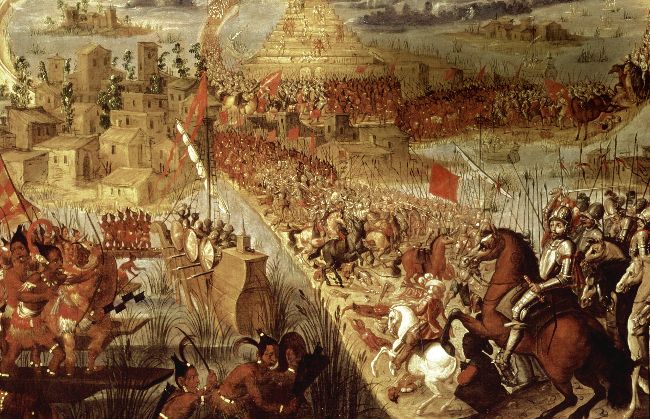
OFF TO CONQUER THE (NEW) WORLD Cortés leads his troops into battle, raining fire and fury down on the Aztec capital
ALAMY X1, GETTY X1
While growing up a sickly child in the village of Medellín, Spain, Hernán Cortés’s mind was filled with stories of Christopher Columbus and his discoveries in the New World.
Such tales were exciting the collective imagination of Spain in the last years of the 15th century. Indeed, he wasn’t the only young Spanish boy inspired by these adventures – his generation would form the next wave of explorers, the conquistadores – but even by their ruthless standard, Cortés would become exceptional. He was destined to bring about the downfall of one of the largest and most sophisticated indigenous empires of the Americas: the Aztecs.
Perhaps it was in the blood – his second cousin, Francisco Pizarro, would later topple the Inca in Peru – but Cortés’s extraordinary escapade began with an expedition that, by rights, should never even have departed.
RASCAL AND REBEL
Cortés had been in the Americas for 14 years by the time he landed in Mexico, having first washed up on the island of Hispaniola (now Haiti and the Dominican Republic) as a precocious 18 year old in 1504. He would have arrived earlier, if a nasty injury allegedly suffered while hastily escaping from the window of a lady’s bedchamber hadn’t made him miss his first boat. Nonetheless, a passion for something other than the opposite sex was about to be awoken in the young adventurer.
His response to Hispaniola’s Governor, when given a land grant upon arrival, was a hint of what was to come: “But I came to get gold,” the teenager said, “not to till the soil, like a peasant.” Already, he had a hunger for New World riches, which would later turn into the full-blown gold lust that underpinned his expeditions. But initially, albeit reluctantly, he took up the role of farmer.
Within two years, he saw military action in parts of Hispaniola and Cuba, in return for which he was awarded more land and an encomienda – an allotment of indigenous labourers under a feudal-style system, often indistinguishable from slavery. Despite several scandals over love a airs, his social standing grew, as did his ambition.