TALKING TOONS
In 1988, Brian J. Robb interviewed Oscar-winning animator Chuck Jones, uncovering his career during the golden age of American animation at Termite Terrace and beyond…
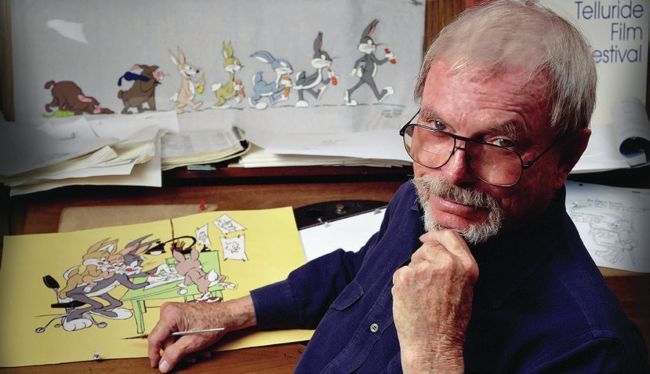
Above: Charles Martin “Chuck” Jones seen at a film festival in 1985
Everyone has almost certainly seen a Chuck Jones animated cartoon at some point in their lives, if not on the cinema screen for which they were intended then certainly as a schedule filler on television. For several decades there have even been entire networks built around cartoons, mixing classics from the golden age of the 1940s and 1950s with more recent productions.
The Warner Bros. cartoon studio, at which Chuck Jones was one of the main animators and directors, closed down in the early-1960s after almost three decades.
But due to the continued exposure, there is as much interest as ever in these classic cartoons, and, increasingly, in the people who made them. Acclaimed animator Chuck Jones helped create and refine several of the world’s best-loved characters, from the wisecracking Bugs Bunny to the anarchic Daffy Duck, and was behind the battle of wits between the rascally Road Runner and the everhungry Wile E. Coyote. From the 1930s to the 1960s, Jones worked at Warner Bros., home of the perennially popular Looney Tunes and Merrie Melodies cartoons. He was behind many favourite Warner Bros. cartoons such as the deconstructive Duck Amuck (1953) and the action-filled What’s Opera, Doc? (1957).
‘The whole thing started with the 1933 [short] Three Little Pigs,’ Jones told me at the National Film Theatre in 1988. He joined Warner Bros. in 1933, where the Leon Schlesinger unit was making the Looney Tunes and Merrie Melodies cartoons. Three Little Pigs was an Oscar-winning Disney-produced Silly Symphony, but it showed Jones and his fellow Warner Bros. animators, including Tex Avery and Bob Clampett, a new way of developing distinctive cartoon characters.
‘We realised here were three characters that looked exactly alike, but acted differently. The way you determined who they were was in the way they moved, rather than by the way they were drawn. The characters started looking less funny, but acting more funny. None of them are funny in themselves.’
ART EDUCATION
Jones had other, more diverse influences. Born in Washington in 1912 , he grew up in Los Angeles, where his family moved in the early-1920s. ‘I was raised in Hollywood. We lived on Sunset Boulevard, where my father had an orange grove, just two blocks from the [Charlie] Chaplin studio [on La Brea]. We spent a lot of time at the beach and saw the Keystone Kops in action. Whenever they wanted a crowd they would ask everyone on the beach, and I was very good at being a crowd! Having watched Chaplin work, I saw the comedian’s precision. Their desire for perfect timing was beyond belief.’