OPENSTREETMAP
OpenStreetMap: map or be mapped
Credit: www.openstreetmap.org
Marco Fioretti shows why and how you could make the world a better place, by mapping it the open source way.
OUR EXPERT
Marco Fioretti is an open source trainer and writer, and an aspiring polymath, writing about all things digital at https:// mfioretti.com and https:mfioretti. substack.com.
QUICK TIP
The first and, more often than not, the biggest error that too many beginner OSM contributors make is to never contribute, for fear of making mistakes.
Don’t be one of those people!
Maps have always been tools of power. About 30 years ago, Bernard Nietschmann, professor of geography at Berkeley, warned people that, “Either you will map or you will be mapped.” Indeed, even if many people never realise it, whoever succeeds in making their map the default one of some area greatly influences what everybody else may learn about its history and culture, or propose to improve it, from wildlife management to land property reforms. That’s why Nietschmann always helped indigenous people to, quoting from his obituary, “chart their own fate”. The OpenStreetMap project, or OSM for short (https://openstreetmap.org), created in 2004, gives the same opportunity to every indigenous of our planet, first-world urbanites included. This tutorial, which is split into three parts, explains why and how you could do just that.
This first parts covers the technical and community bases of OSM, whose knowledge is necessary to participate in the most effective way, and introduces the simplest tools to do it. The second part will build on that to explain JOSM, a very popular, open source OSM editor. The final part will describe more advanced or lesser-known ways to use or improve your maps.
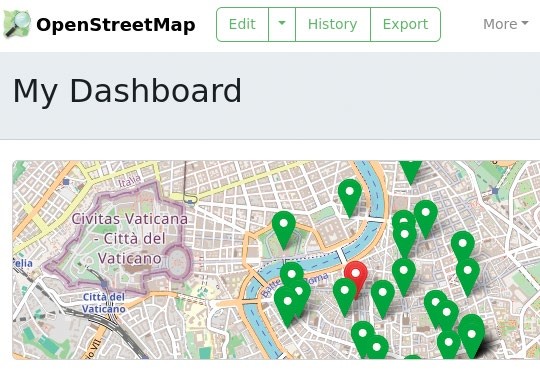
In the OSM world, you are never alone. Just sign in, enter your location, and some fellow OSM mappers will surely show up close to you.
Make the world a mapper place
Consider the answers given to a challenge issued on the Facebook OSM community page on 23 October 2024, about “mapping hidden gems ... places people may not know about but should”. One editor mapped a scout camp because he has “many, many memories created there, and it is special to me to know that I’ve helped many others do the same through my work. I take particular pride lately in that every single signpost is mapped.” Another mapped a labyrinth in his small German town because it’s shaped like “the lion of the city’s coat of arms and is made of elephant grass, as a part of a climate protection project”. At a higher level, OSM saves lives. When major earthquakes hit Haiti in 2010 and Nepal in 2015, the search and rescue teams could assist the victims more effectively thanks to the volunteers of the Humanitarian OSM Team (HOT), who immediately updated the maps of those areas. In the same years, OSM was the most accurate, if not the only, digital map that ambulance drivers in Gaza could use to reach victims of accidents. Only a really open resource, welcoming all contributions and freely reusable for any purpose, could achieve small and big results like these. Maps locked by copyright restrictions or bound to maximise shareholder profits could never be so detailed, customisable and quick to update.