New insights into venom
Caecilians are limbless amphibians that, to the untrained eye, can be easily mistaken for snakes. Though caecilians are only distantly related to their reptilian cousins, researchers have discovered specialised glands found along the teeth of the ringed caecilian (Siphonops annulatus), which have the same biological origin and possibly a similar function to the venom glands of snakes. If further research can confirm that the glands contain venom, caecilians may represent the oldest land-dwelling vertebrate animal with venom glands in their mouth.
A little-studied group
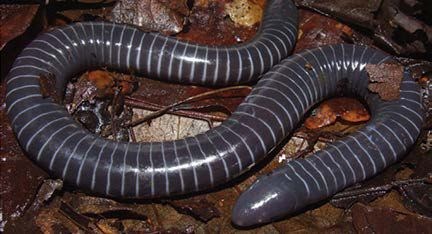
The ringed caecilians was the subject of this study.
Photo courtesy Dias I/CC BY 4.0.
This group of amphibians are peculiar creatures, being nearly blind and relying on a combination of facial tentacles and slime to navigate their underground tunnels. "They produce two types of secretions: one that is poisonous is found mostly in the tail, while the head produces a mucus to help with crawling through the earth," explains Carlos Jared, a biologist and Director of the Structural Biology Lab at the Butantan Institute in São Paulo. “But because caecilians are one of the least-studied vertebrates, their biology is a black box full of surprises.”