Introducing an identity fraudster amongst snakes
How to look after and breed Bismarck pythons
Remember the story about the ugly duckling? Well, picture it in reverse, removing the bird and water, and substitute a snake and a group of islands. Meet the Bismarck python. Christian Castille provides a definitive account of these snakes.
This particular species was first described in 1837 by a German ornithologist called Hermann Schlegel, being included his book on snakes called Essai sur la physionomie des serpens. He named it as the Tortrix boa, following its discovery by Prosper Garnot and René Lesson on the island of New Ireland, which lies to the east of New Guinea. Despite the fact that its name has now been changed, the majority of scientific literature about this species is still to be found under the name of Nardoa boa. This is because the world-renowned zoologist and taxonomist George Albert Boulenger named it accordingly in his description which appeared in the highly influential Catalogue of the snakes in the British Museum (Natural History).
The species description of boa is still in use today, in spite of the fact that these snakes are actually pythons, with their scientific name now being Bothrochilus boa. The reason for this is because of the name that Schlegel originally gave to them. Even at that early stage though, there were doubters! John Edward Gray wrote in 1849 in one of the museum catalogues how he personally felt that Schlegel’s classification was inconsistent and that this snake had too many resemblances to other Indonesian constrictors. He was also the first and only person to change not only the genus but also the species’ name of the snake in 1842, although his views were essentially ignored.
The significance of scale patterns in snakes
Most scientific papers follow the same description of scalation, as far as Bismarck pythons are concerned. The scale patterning is therefore as follows:- dorsal mid-body 34-39, ventrals 245-267, subcaudals 45-54 almost all paired, single anal plate, small loreal scale, supralabial scales 9-12 with 4th to 6th touching the eye, infralabials 12-13, single preocular and 2-3 postoculars, one pair of prefrontals, two pairs of parietals and a small interparietal may be present.
The reason I have included this information in the article is because prior to 1837, these snakes were not classified and only had local, native names. Going back earlier, before 1735, the Linnaean taxonomic system that we now use simply did not exist either, making reviewing and researching earlier information about this snake impossible from its name.
However, scalation counts were still conducted on snakes and recorded before biological classification. By using the above data therefore, you can still search for records of this snake in very old literature without needing a name for it. The same applies for other species as well, which is why scalation counts can be very significant in a historical sense.
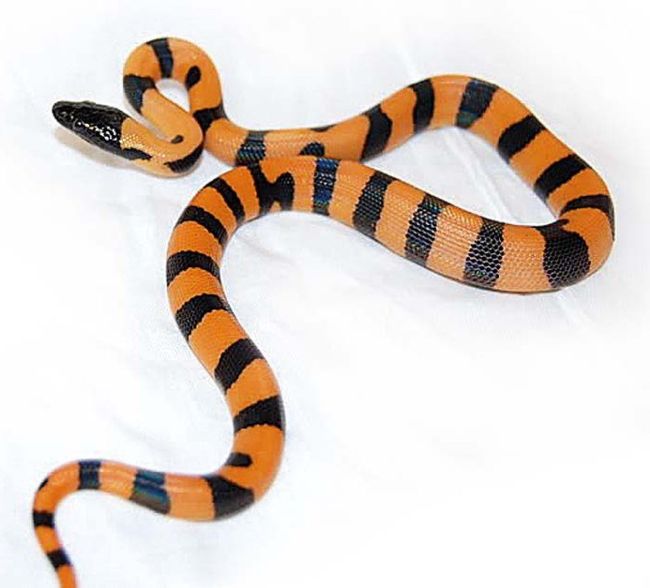
An example of the flamboyant colours of the young prior to maturity.
© Tom Keogan.
Always popular
The stunning appearance of young Bismarck pythons has meant they have always attracted attention. On the 30th June 1919, Mr Longman placed a number of these pythons on display at the Royal Society of Queensland, Australia. The snakes, which originated from Rabaul in New Britain, proved so popular that the Queensland museum used them to attract paying visitors.
Since then, however, in spite of a great deal of interest in this species, virtually nothing has been written about the care and breeding of this species. As its name suggests, it originates from islands which form the Bismarck Archipelago, a group lying off the northeastern coast of New Guinea in the Pacific Ocean. The two main areas from where today’s captive-bred strains originate are the islands around the east coast of Papua New Guinea itself, and New Ireland also allowed the export of these snakes up until 1977. This means that bloodlines are somewhat restricted.
Morphing with age
Some people are deterred from acquiring these snakes, because of their change in appearance as they mature. They morph from a colourful hatchling into what in some people’s eyes is a drab and dull-looking adult. My view is different, because I actually think that the adult colours are much more stunning than those of the babies. I like their iridescence, which reminds me of white-lipped pythons (Leiopython albertisii) , and their velvet-like appearance. Even with a duller tone, they still manage to maintain their air of beauty and mystery for me.
There are a number of possible explanations for the change in appearance of Bismarck pythons as they mature. According to the Harvard University Museum of Comparative Zoology, the reason these snakes are so colourful at birth and stay this way until they are about six months old when they begin their colour change is to replicate the look of a highly venomous sea snake (Bungarus fasciatus). This deters predators from hunting and eating them at this vulnerable stage. These snakes are small and slender at birth, leaving them essentially unable to defend themselves.